Daily Mail 6.1.14
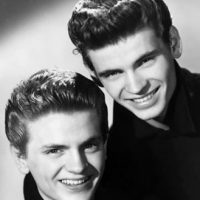
They looked like a couple of teenage Mississippi riverboat gamblers, thin as blades with their white shirts, black waistcoats and luxuriant hair. But when they picked up those black guitars, stood head to head close to the microphone and sang, a generation of budding schoolboy musicians pricked up its collective ears and listened.
They were the Everly Brothers, Don and Phil, just 19 and 17, and back in the late Fifties when rock was young, too, they made a kind of music that was to outlast their own period in the spotlight by decades.
Now there’s just one Everly Brother, Phil having died of complications of lung disease in a Los Angeles hospital on Friday, aged 74 – a result, his widow Patti said, of a lifetime of smoking.
Last night Don Everly was in mourning for his younger brother, but while the Everlys were famous for their close harmony on record, off stage there was for many years little concord in their relationship. As Phil said in 1970: ‘We only ever had one argument. It’s been lasting for 25 years.’
He was just 31 at the time and was soon to part company with Don for the best part of a decade, when the older singer turned up drunk at a gig in California in 1973. After mangling the lyrics of Cathy’s Clown, which they’d written together, soon he and Phil were arguing on stage, before, according to some reports, Don chucked his guitar down, saying: “I’m through with being an Everly Brother.”
Phil, always the more stable of the two, journeyed on alone through the rest of the show, until aggravated by hecklers he shouted back: “The Everly Brothers died ten years ago.” (Other versions of the story say that it was Don who stayed to finish the set.)
Rock groups have always had their rows and breaks ups, but the Everlys were family. It didn’t seem right. But when, a decade later, they reunited for a tour, they just didn’t get on.
I caught a glimpse of this in 1984, when they agreed to make their first new album in years for fellow rock star and producer Dave Edmunds. My job was to interview them for a promotional documentary which was being released with the album, the idea being that they would talk about their careers.
Unfortunately they wouldn’t sit down together. Just when I thought I’d got them side by side in front of the camera, one or the other would get up and leave. In the end we settled for separate interviews.
‘It’s the same when they sing,’ Dave Edmunds, whom I’d known since he recorded the music for the film Stardust, told me as we paused in the filming. ‘Phil always wants me to record Don first, saying that he’ll add his harmony afterwards – although he knows it doesn’t sound as good when they do it that way.’
Only on stage would they sing together. That was the warring Everly Brothers, who were, as far as I could see, unfailingly friendly to everyone but each other.
So where did the animosity and sibling rivalry come from? Perhaps being forced to sing together from childhood, when they would perform in the US Mid-West on their family’s country and western radio show, left scars that never healed.
Most brothers are allowed to go their own way in life. The Everlys were tied together by the beauty of their voices, with the early fame of Bye Bye Love and All I Have To Do Is Dream locking them even closer. Each might have preferred a solo career, but when they did eventually go solo, neither sounded as good or had anything like the same success.
I got some indication of how far back the enmity might go when a mutual friend who was working with them and staying in an adjoining motel room accidentally overheard a row between the brothers, then in their forties, which carried on into the early hours.
The spark of the row was impossible to tell, but between the shouting and sobbing, over and over again she heard both singers referring to their father, guitarist Ike Everly, who had nurtured their early carers.
‘Daddy said this…’ and ‘Daddy that…’ went the allegations and counter allegations, words which might have come from one of the brothers’ earliest LPs, Songs Our Daddy Taught Us, had they not been so filled with rancour and recrimination.
That, as adults, they weren’t more able to more enjoy the gift they shared is sad, and perhaps there’s some truth in the suggestion that Don Everly always felt he was upstaged by younger brother Phil, the one with the sweet lilting tenor voice. ‘I’ve been a has-been since I was ten,’ he is alleged to have said. It was a grudge he needn’t have carried, since his guitar playing brought the rhythm and his voice the perfect harmony to the pair.
British fans didn’t realise it, but the first signs of the Everlys’ problems appeared on their first tour of the UK in 1962, when Don, who was addicted to prescription drugs, had a nervous breakdown, and, it is said, made a suicide attempt, leaving Phil to carry on the tour alone.
They were at the very peak of their fame, but soon disastrous business decisions and the rise of the Beatles, who had learned so much from them, were making them look old fashioned. Gradually the hits dried up. Phil Everly used to say that ‘the Sixties weren’t his cup of tea’, while it was said that Don privately hated the Beatles for taking their crown.
It was nothing personal, of course, and the Everlys were later happy to record a Paul McCartney song and were friends with George Harrison. But by that time, despite Phil having a hit when he duetted on She Means Nothing To Me with Cliff Richard that year, they were a part of pop history.
But what a legacy they left for those schoolboy musicians who’d been among their earliest fans. When Paul Simon recorded his album Graceland, he called the Everlys in to sing back-up vocals on the title track. And when he and Garfunkel reunited and played in London’s Hyde Park in 2003, the duo interrupted their own act by bringing on Don and Phil to sing, a generous homage to the sound they’d copied.
Until last Friday there were probably still stalwart Everly fans hoping that the brothers might get back together for one last album or tour.
That can’t happen now. But few artists will garner the tributes that were paid to Phil Everly over the weekend as Bob Dylan, Tim Rice, Brian May, Gary Barlow, both Paul Simon and Art Garfunkel and dozens more tweeted their thanks to one half of the duo that created the most harmonious part of rock music.
