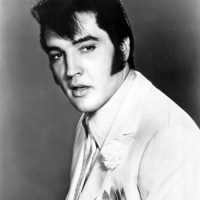
What is the point of Elvis Presley? I don’t mean, why is Elvis famous? Even if you don’t care for his style of music you must admit that getting on for four decades after his death, he remains the most recognised performer in the world, with fans still numbered in millions.
What I’m wondering is how did he come to leave such an indelible mark on the world, to the extent that he is still known universally by his Christian name alone, be it in admiration or as part of a joke? Why Elvis, and not some other singer out of the thousands who have entertained us these past sixty years?
Vaguely reflecting on this, I made my way around the Elvis At The 02 exhibition this week, hoping to get some better understanding of the man by seeing the three hundred or so artifacts that have been shipped from the singer’s museum of a home, Graceland, in Memphis, Tennessee.
Certainly there are some illuminating items, not least an ancient wooden trunk which was found in the Graceland attic after the singer died, and which contained his junior school reports and his father Vernon’s puny income tax return for 1947. He earned less than two thousand dollars.
According to Graceland’s archivist, Angie Marchese, the trunk was filled with the Presley family’s few valuables and stuffed into the back of their old car when in 1948 the Presleys left the poverty of small town Tupelo, Mississippi, to hopefully find a new life in the city of Memphis. Elvis was a shy thirteen year old. Six years later he was making records. The gamble paid off.
What neither the archivist nor the exhibition mention was that Vernon had just lost his job driving a wholesale grocery truck in Tupelo, probably, it is believed, because he was bootlegging a little moonshine on his rounds.
That doesn’t necessarily reflect badly on Vernon. Bootlegging was illegal, but hardly uncommon in Mississippi. But it does, I think, give some indication of the social status of the Presley family at the time.
Nor did I spot any paperwork in the exhibition about the several months that Vernon spent in prison for a quite minor crime (which would never have led to jail in the UK) when Elvis wasn’t much more than a toddler. Understandably the Presleys never liked to talk about the imprisonment, but the enforced separation from his father might help us understand the singer’s extraordinary closeness to his mother, Gladys. A simple, pretty blue cotton dress belonging to Gladys (who died in 1958) was saved by him and is in the collection.
It is well known that religion played a large part in the lives of the Presley family, and there are various very well thumbed Bibles on show, as well as the singer’s albums of hymns. But what comes as quite the biggest surprise is the medieval looking three foot high plaster statue of the Sacred Heart of Jesus, (that is Jesus, with his red, bleeding, suffering heart outside his vestments) that Elvis had standing by his bed in Graceland.
It’s the kind of ornament you might see in a Catholic church, but not, I would have thought, in the kind of Southern Baptist chapel in which the Presleys worshipped. Among all the bling, the gold telephone, the gold boxing gloves that Muhammad Ali gave him, the diamond ring as big as a mouse, the guitars and the white whale of a Lincoln Continental that he bought in his first flush of wealth, it stands out as a window into a more interesting side of the singer that might have been further pursued.
Only rarely in displays that are given over mainly to image, does the internal life of the star emerge. A lonely, introspective man, locked in by fame, who never gave in-depth Press interviews, appeared in TV chat shows or attended Hollywood premieres with other stars, he had an abiding interest in the spiritual.
And a much read and annotated ancient copy of the clairvoyant Cheiro’s Book Of World Predictions was, we are told, also kept in his bedroom. Suffering from a chronic inability to sleep, did he spend his nights seeking some mystical sign which might explain himself?
Never much of a reader of fiction, he was, however, keen on the statistics in American football, world history and even had a copy of the Warren’s Commission’s report on the assassination of President Kennedy.
As you might expect in this mainly vanilla depiction of the singer, there is nothing here to suggest his dependence in later years on prescription drugs, or the suspected financial chicanery of his manager, the late, vanity titled Colonel Tom Parker.
But a darker side again just about peeps through in the rambling letter that he wrote by hand while on board an American Airlines flight to Washington to see President Nixon in 1970. After a row with his father and his wife, Priscilla, about his excessively extravagant spending habits, he decided on a whim he wanted to be given a Bureau of Narcotics and Dangerous Drugs badge by the President of the United States, and turned up unannounced, and, ironically enough, high on amphetamines at the White House. Low on paranoia, Nixon obliged, and the badge is here in a glass case.
My interest in Elvis Presley has always been about the music, first and last, but seeing his record player isn’t quite as revealing as knowing what was on his juke box when he died, and no-one apparently seems to know. He had, as you might expect, a very large record collection, although, the archivist admits, he didn’t have a full complement of his own albums.
Which means, I suppose, that not even he would give house room to Paradise Hawaiian Style. That’s understandable. He always did have good musical taste, even if the demands of his movies meant that he didn’t always use it when recording.
What are on show, in nods to his debt to black music, are records by Roy Hamilton, one of his favourite singers, and Memphis blues guitarist B.B. King, as well as a couple by Tom Jones and Frank Sinatra. Considering that Sinatra one referred obliquely to him as a ‘cretinous goon’ and to rock and roll as a ‘rancid smelling aphrodisiac’ I think that shows a commendable sense of forgiveness.
As you’d expect in an exhibition devoted to a guy who looked like a Greek god there are many huge and beautiful black and white photographs of the singer is his youthful prime, but I’m not sure I was ready for the squad of bejewelled and tassled white jump suits from his later Las Vegas days. One would have said it all.
It’s possible to mock them as examples of his kitsch Seventies style – although he wasn’t the only one to go over the top in that decade. But he had always dressed flashily on stage and there was a reason for it. As the Queen always wears light coloured coats so that the people can see her, Elvis wore the most exaggerated stage suits to amuse and give his fans a show.
Apparently he owned around a hundred similar suits, and the Graceland people can knock up a made to measure replica for you for around £2000. To the best of my knowledge neither Prince William nor even Prince Harry ordered one when they visited the main museum at Graceland during their visit to Memphis last summer.
Some might suggest that an interest in seeing the bits and pieces of the life of a dead star is akin to a quasi-religious experience, a guitar taking the place of , say, a relic of the true cross. But it seems to me that there’s nothing sinister in Elvis fans wanting to get a glimpse of the ephemera of a remote and mysterious individual, whose voice has been part of their lives.
And if they want to see his hats, his shoes, his army fatigues, his American Express card, the golf buggy that he ludicrously bought for his daughter when she was seven, this, like the best rock and roll memorabilia auction you’ve ever seen – but without the actual auctioning, is the place to find them.
But I return to my question, what is the point of Elvis Presley? And it seems to me that the Graceland business people who now run everything Elvis and I will never agree on this.
To them the point is Elvis the industry – to present a bland version of the troubled star that welcomes over 600,000 fans a year to wander through Graceland, making it the second biggest visited house in America after The White House. Their vision shows the airbrushed Elvis of incredible fame and conspicuous glamour and wealth, but reveals little of the forces and people who helped create him and the demons that brought him down.
And as fans leave the exhibition, they will, as at any other exhibition, find themselves in an Aladdin’s cave of Elvis merchandise of T-shirts, replica gold records, scarves, sunglasses, postcards, records, books, etc.. You wouldn’t expect anything else from the people behind Elvis the Industry.
For me, however, the point about Elvis is his musical and cultural importance, his fusing of black and white music in his early recordings, the intensity of his emotion in his two and a half octave voice, his ambition, attitude and singularity of purpose in taking on the conservative forces of entertainment in the mid-Fifties.
As a young man, he personified rock music and the changing times, and made it possible for the following generation of John Lennon, Keith Richards, Bruce Springsteen, Bob Dylan and many more, as all have attested, to follow their own ambitions.
You don’t hear much of Elvis on the radio any more, though his recordings are endlessly repackaged, with modern digital techniques being used to make them sound dance contemporary. By comparison the Beatles left a much more musically interesting musical heritage.
That’s fair enough. He was of his moment, the great original. That, not the souvenirs and T-shirts, is surely the real point about Elvis Presley.
