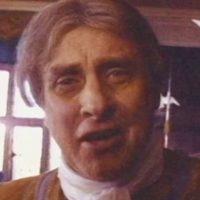
Evening Standard, June 1971
Spike Milligan reckons he was born a clown – just as some people are born with funny shaped noses or whatever. In fact one of his earliest memories has him as a little boy of seven playing a clown in the school Christmas play.
‘I remember it so clearly,’ he says. ‘They’d given me blue to put on my face and I thought it should have been black. And then the last scene, when all the other children were crowded round the Virgin and Child I wasn’t supposed to go on, but I did anyway. It didn’t seem fair. So I went on and stood alongside the manger with the others. I thought the clown had a part in life.
‘It’s strange, but that little cameo in my early life says it all.’
Spike Milligan lives, sleeps and works Mondays to Fridays from a cluttered, jammed yet neat little office in Bayswater. There’s so much work to be done he just has to be there, he says, and when he is there, he isn’t inflicting his neuroses upon his family. Then at the weekend he can go home to Finchley to his semi-detached, four children, wife, au pair, nannie and dog.
Yesterday he was getting over a boozy night out – the result of a reception held for him by the publishers of his new book, Adolf Hitler – My Part in his Downfall and suffering from a miserable bout of catarrh. He looks so gentle and fragile that a jolt might shatter him.
At fifty-four, his mind continuously races in as many directions as a mind can go at any one time, and the room is crammed with box files where he’s collected odd thoughts which might someday be useful. He calls these thoughts ‘mind furniture’.
What is he working on right now? I ask, and he grabs a pile of letters, circulars and scribblings.
‘Today?’ he asks. ‘Well, people write to me all the time asking me what I can do to help them, so I do what I can. I’m a member of all the anti-cruelty and anti-vivisection societies there are, for instance. You wouldn’t believe how much cruelty there is to animals in the manufacture of women’s cosmetics.
‘Then here, you see, I’m vegetarian. Then here’ … and he picks up a pile of drawings … ‘I’m a member of the Finchley Society, which was formed because in Finchley there is no attempt in any way to preserve things of architectural interest.
‘Basically, I’m working for the human race. And when I’ve time I try to get a bit of work done for myself. Every day I try to write down some comedy. I’m under contract to the Marty Feldman Show as a writer and a performer, so I’ve written masses of stuff for that.’
On the shelves are files which say God! Ha! Ha! – ‘I thought of writing a comedy version of the Bible: it must have been a very happy occasion when the world was created’ – and others devoted to children’s poems. One Christmas he taped masses of children’s conversations. It would, he thinks, make a lovely book.
He’s everything – from serious poet, to songwriter, to cartoonist, and as he talks his hands wander through sheaves of paper haphazardly.
His new book is an autobiographical account of his own youth in the army during the Second World War. It is very funny indeed. It is also, he insists, a true account of the way things were.
What of the complaints, which have already been made, that the war was nothing to laugh at?
‘Well, you expect some people to complain, don’t you? It’s the dead soldier syndrome. These people live permanently being humble about the war as though it were a medal of respectability. But for the dead it’s a private thing. I lost my mates in the war, too. I still get a pension because of the war.
‘I got wounded in the leg and became a neurotic with a chronic anxiety state. I got shakes – and, like you, I got a stammer. Every time a gun went off I started to stammer. Even now when I get very uptight I stammer.’
His injury, which was caused by a shell blast, changed his life tremendously. Before it, he was very nice and easy-going and people took tremendous advantage of him, and consequently he tried to do as much for everyone as he could.
‘Somehow when I got blown up it made a positive decision about whether or not I was a neurotic, and it eventually resulted in my nervous breakdown in 1956.’
‘I just went on working and going until I couldn’t stand it any longer. I don’t want it to happen again. I’m much more aware now. I won’t let them screw me up again. Sometimes when it gets on top of me I just take a whole pile of letters and throw them away rather than answer them.
‘I hate doing it, but I have to. It’s the only way.’
In a strange way he believes that the war saved him from what he might have been – ‘probably a foreman by now at Woolwich Arsenal and wondering why I was unhappy.
‘Adolf was my salvation.’
Before he received his ‘cunningly worded invitation to partake in World War II’ Spike (christened Terence) had been a quiet, protected lad from South East London, who had a passion for playing the trumpet and a seemingly dull future ahead of him.
The war changed everything, and by the time he was demobbed in 1947 he was a different man, making his living playing with a little jazz trio and touring the armed forces all over Italy.
‘Eventually when I came back to England in 1949 Val Parnell came to see us, but he wasn’t interested and after a miserable time touring I left the others and went to work as a barman in Westminster. As it happened, the owner of the pub used to write scripts for Derek Roy and when he heard me cracking jokes he invited me to help him.’
Later came the Goon Show, and then the rest.
‘But it wasn’t until I played Oblimov on the stage that I realised I was a very good clown. I was forty-four. Maybe it was too late. I’d very much like to have done comedy in films, but I haven’t. And I wonder how people who are less funny than I am have got into it. I’m not sorry for myself. Just puzzled.’
He is funny on virtually everything he talks about and his bright blue eyes just smile away kindly all the time, but he’s funniest of all when he recounts tales of his troubles with his bank (despite an income of something like £40,000 a year).
‘You know,’ he says, ‘they sent me a letter saying it had come to their notice that I was £5000 overdrawn on my current account and would I like to drop in and see them. So I answered “How dare you?” and pointed out that in my deposit account I had eighteen shillings.
‘So they duly answered saying “yes” they’d transferred the eighteen shillings but they noticed that I was still £4999 2s overdrawn, and would I like to go to lunch.
‘So I answered “How dare you!” but if they were to put the cost of the lunch to my overdraft it would reduce it still further. Then when they wrote again I answered that it was my habit of putting the names of all my creditors into a hat once a month, and if they didn’t stop pestering me with their letters I wouldn’t put their name in next time.’
