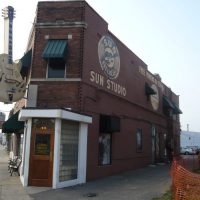
Sam Phillips Plus Johnny Cash, Carl Perkins and Roy Orbison
(Radio Times, September 1973)
“Until rock and roll music came along the grossest of all racial discrimination in America was in music. You had pop music – which was for a certain type of people; you had country and western music, which was supposedly for another class, and you had what we called in those days ‘race’ music. So if you’re talking about segregation there was no better example of it than in music, and I just hope that I played some part in breaking that down in some way.”
This is Sam Phillips talking: Sam Phillips, the man who discovered Elvis Presley, Johnny Cash, Carl Perkins, Roy Orbison and Jerry Lee Lewis, and who, by a unique blending of musical styles in the mid-50s, produced a style which has been copied, restructured and repeatedly built upon to form the variety of types of rock which have dominated American and derivative musical styles over the last 20 years.
Phillips now leaves the running of Sun studios in the hands of his son Knox. Times and techniques have moved a long way since Phillips first began recording, and he doesn’t try to compete with today’s electronic sophistication.
But the story of the birth of rock and roll in the mid-50s is very much the story of Sam Phillips. As he saw it pop and country music then were stagnant, and the really exciting sounds were coming from the rhythm and blues artists.
Now 50, and semi-retired in Memphis, Tennessee, he recalls: “It seemed to me that the young people couldn’t identify with the music the adults liked, and the only music they could identify with was race music. It had a certain abandon, and it was something that parents didn’t particularly dig.
“I think my own background helped me enormously. I came from a very poor family in the Muscle Shoals area of Alabama and I’d grown up to a large degree with both poor black people and poor whites.
“I saw an awful lot of fear in the black man’s eyes in those days, and how they had come to think of themselves as something different over the years, so that the only things they could do privately were their music and their religion. And I felt that the way they sang and preached just had to have some merit in it.”
By the time he was 27 Phillips had become a radio disc jockey and accomplished sound engineer. With some meagre savings he built his own recording studio in a rented one-storey building in a poor area of Memphis. The whole studio wasn’t bigger than a decent sized hotel room.
“I realised at that time that there was no place in the South that a black man could go to make a record. I knew there was a lot of black talent around, but I also knew that those people had no way of getting to Chicago or New York let alone the West Coast. And I also knew that if they did the major labels weren’t doing that much recording of black artists anyway. So in 1950 I opened up, and to pay the rent I would record weddings and funerals and conventions and such things, at the same time looking for new talent.!
One of the first artists he recorded was guitarist B. B. King, then Ike Turner, Howling Wolf, Rufus Thomas and Junior Parker, and after a short time the word got around that there was a modest place in Memphis where a man could go to make a record; where he wouldn’t be paid any money so far as royalty advances were concerned, since there wasn’t any money available, but where he would certainly get a good listen.
“The most difficult thing I had to do was to impress upon them that they were welcome to come and try to do what they did best, but that I didn’t want anyone trying to sound like Nat King Cole or something they weren’t. It wasn’t so much a communication problem, as the fact that they were inhibited, and wanted to play music that they thought would please me.
“So eventually I’d find myself saying ‘I want some blues. I want your soul poured out on this damn floor’. And one of the first groups I got to recording properly for Sun was Little Junior Parker, who suddenly lit up with a song he hadn’t even finished, but which we called Mystery Train.’ “
By 1954, he still had to record a white singer professionally. “I remember one day I was in the studio and I noticed this young boy walking up and down outside the studio. I thought at first that he was one of the workers from the radiator shop next door, but he eventually came in, and my secretary (who’d spoken to him before) told me that he wanted to cut a record for his mother’s birthday. I said at first that I was too busy that day, but he explained that it was her birthday the next day and he just had to have it.
“So I thought well if the boy cares so much about his mother’s present then I can take a little time out to record him. Personal records cost three dollars at that time. So he came in, and hung his guitar round his neck, and we talked a little bit, and I gathered that he was called Elvis Presley, was 18 and lived in a very poor area. I saw in his eyes that same look of fear that was in the black man’s eyes, that he might be somewhere off bounds for the likes of him.
“I tried to put him at ease, and I let him sing a little to practise before I cut the record, and we used a piece of scrap record I had lying around, just so that he could get the confidence.
“I’ll never forget the look of amazement when he heard himself on record – amazement not at the way he sounded when he sang, but also that someone should be treating him with such respect.
“I knew then there was something distinctive about him. He liked the same music that I did, good gut-bucket blues, and he really was a student of Arthur Crudup and Leadbelly and people like that, which was amazing in a boy so young. I remember he said he used to practise in his bedroom at night.”
For months Sam tried the young Elvis out on a series of different sounds with guitarist Scotty Moore and bass player Bill Black. At first nothing went right, and although he realised he’d made a mistake with the first song he’d found, he became increasingly interested with Elvis’s style. Then one night it all clicked into place, when Elvis began singing a blues song he knew.
‘He just came out with That’s All Right, Mama, and I just knew we had something different. I remember that night well because we’d spent hours in the studio and Bill Black had been ready to go home to start repairing refrigerators because that was what he did for a living, and had to take his bass out of his case again. We didn’t take no more than three cuts of that song, and we used the second one on the record.
“I was so delighted I said ‘Y’all have come off fantastic tonight, because if this isn’t good enough then, Lord knows, I don’t know which direction to go in’. I knew we had something that wasn’t fish and wasn’t fowl, but that had tremendous excitement and abandon.” It was in fact the beginning of the Sam Phillips version of rock and roll music, Although he’d had successes with black records, at first Phillips encountered innumerable difficulties in getting his first Elvis record played on any of the stations.
“I went on the road with that one record, and although I couldn’t actually find anyone who was prepared to play it, I kept getting favourable reactions from both the black disc jockeys and the white ones.”
Eventually, of course, someone did play it, and within three weeks it was a hit all over the South. Eighteen months later Elvis left Sun when RCA Victor paid Phillips a record of 40,000 dollars for him in the autumn on 1955. But Phillips had now broken through, and Sun Records had become a magnet for young white talent from all over the southern states.
Johnny Cash was one of the first to arrive. Says Cash: “As soon as I got out of the Navy I made up my mind I was going to sing on records and when I heard this boy Presley on the radio I decided to call Sam Phillips. I guess I must have called 20 times before I actually got to speak to him, and he eventually had me in for an audition. He told me he liked what I sang (he did Folsom Prison Blues) and asked me to go home and write some more songs.
“In a way we all stood in awe of Sam. He was older than us, although still only in his early 30s, but he had great power of concentration and determination. I remember at one of Elvis’s sessions we were all hanging around and Elvis was trying to do a ballad and Sam kept saying to him ‘Do things like That’s All Right and Mystery Train. That’s what the public want to hear from you, Elvis.” And Elvis came over to me and said ‘John, I wish you would tell that man for me that I can sing a ballad as good as anyone’.
“But I said, ‘I ain’t gonna tell him no way. You tell him yourself’. Poor Elvis was still trying to get Sam to let him record I Was The One”when he left to join RCA Victor. And that was the first song he made for them.”
Cash thinks that Phillips’s major contribution was that he brought music back to its very rawness, and wouldn’t allow anyone to be other than earthy.
‘Carl Perkins, Jerry Lee Lewis, Elvis and myself all became like one big family. We’d all know what days we were recording and we’d go and sit in on each other’s records, usually having jam sessions after the records had been cut. I remember one time in about 1957 when Elvis was already with RCA he came back and the four of us sat around the piano and sang hymns. Elvis was playing and we were harmonising with each other. That record was never released, although Sam turned the tapes on and took two hours of tape.’
Although Johnny Cash had enormous hits with I Walk The Line, Ballad of A Teenage Queen and Cry, Cry. Cry for Sun Records, he was later to leave to join Columbia.
Carl Perkins also was attracted to Sun after he heard the first Presley record. For years he’d been playing in small clubs in towns north of Memphis and on hearing about Sun, he decided to drive down and try his luck
Eventually, he managed to get an audition with Phillips who decided to give him a try, and after three records he came up with the million-selling Blue Suede Shoes, a song which Elvis, by then on RCA, immediately covered. It was Sam Phillips first gold record.
“When Sam was recording us we’d spend maybe 18 hours in the studio,” he says. “And half the time we’d never know when he actually had the machines on, so that often he’d catch us at our loosest. Often he’d go out through the front door, and just slip back in through the back to turn on the machines. He was really very innovative. There wasn’t a lot of machinery in there but being a brilliant engineer he knew how to get the best sounds out of it. Half of that echo effect he got by just sticking up a piece of board behind the singer and making him face the wall.
“Sun had really become the place to be recording and I remember going there one day and seeing nine Cadillacs all in a row.”
Jerry Lee Lewis was first hired as a pianist for Car Perkins’ records, earning 15 dollars a session. It wasn’t until he began singing in between takes one day that anyone realised he could sing.
“We were recording Matchbox when suddenly Jerry Lee started doing Crazy Arms. His father had brought him down to work with us, and when Sam heard him, he put him under contract, too.”
After four million-selling singles, however, Jerry Lee’s career was to nosedive when it was discovered by the British press that he had bigamously married his 13-year-old second cousin, and he was hurriedly asked to leave Britain by the Home Secretary.
While most singers left only for financial reasons, a few just didn’t hit it off with Sam Phillips. Roy Orbison was studying English and History at the University of North Texas in case he didn’t make it as a singer, and he became fascinated to know how Phillips got that peculiarly funky echo on his records.
That interested him more than Elvis’s singing, he says now. He made three records for Sam (including the small 1958 hit, Ooby Dooby) but isn’t very proud of any of them.
Whereas Phillips always thought he gave his artists a lot of freedom to play the music that was most honest, Orbison found that he had no freedom at all.
“Sam wanted me to play those fast blues numbers he’d had Elvis doing, but I was more interested in some of my own songs.” They parted on not particularly amicable terms during a royalties dispute but largely because Orbison’s style of music was not particularly suited to Phillips’s interests.
Phillips liked basic blues, played in a slightly countrified way. Orbison was best on numbers which required more production and were more intricate in style. Musically the two were certain to be at odds.
Memphis disc jockey George Klein, a long-time close friend of Presley’s, sums up Sam Phillips’s contribution most aptly when he says: “Sam was the guy who kicked it all off. He took black music and he made white guys sing it.”
Says Sam: “I didn’t want an imitation. I didn’t want someone trying to sound like a black man, I wanted singers who instinctively had a feel for a song, who’d get that emotion across. You’d never believe the amount of prejudice we ran into early on. You’d better believe that if I’ve ever achieved anything then it’s been to help break down some of that prejudice. And I think that rock and roll music has had more favourable impact on the understanding of people of all races and all nationalities than all of what them diplomats have been doing.
“The young aren’t so prejudiced as the old, and if I’ve helped stop some of that prejudice from growing up, then I think I’ve done something.”
