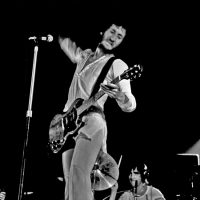
Evening Standard December 1967
The Who are the group who smash up their guitars at the end of their act. They’re the boys who pick their noses (only their own) during Top Of The Pops, and they’re the group who tattoo their umbilici and bosoms with bullseyes and girls’ eyes and appear at gigs wearing only half a shirt each and no vests.
When they perform, they somehow manage to make a noise with their ultra-amplified guitars which sounds like a jet raid on Haiphong, their arms go whirling round like windmills out of control, and they sing songs like ‘My Generation’, which explains itself, ‘Pictures of Lily’, which doesn’t but which is actually about sexual fantasy, and ‘Happy Jack’ which is about a donkey on the Isle of Man.
When Radio London first started plugging their records they were mods, which, you’ll remember, were a new kind of rocker two or three years ago. They wore Union Jack jackets and pretty painted T-shirts and were managed by those colour supplement favourites Kit Lambert and Chris Stamp.
Last week their latest album was released. It is called ‘The Who Sell Out’ and is remarkable because they are still unashamedly playing rock and roll music. (Rock and roll is a dirty word among this year’s golliwogged pop sophisticates.)
It is also a remarkable album because it is made up of a selection of songs naming branded goods like Heinz, Medac and Odorono, all tied together with a collection of nostalgic station identification jingles from Radio London. The effect is that the album sounds rather like a pirate radio programme.
There are four Who: Keith Moon, who clouts his drums like a man deranged, John Entwhistle who is married, Pete Townshend who is the clever one and does most of the composing, and Roger Daltrey who has orange hair and who caught mild pneumonia after sitting in a bath full of frozen baked beans during the photo session for the album cover.
If The Who have an architect or prime mover it is Townshend, twenty-two-year-old ex-Ealing Art College student. ‘It’s all because of me hooter,’ says Townshend, who reckons that he earns about £20,000 a year as a composer and £500 a week as a Who.
‘When I was a kid I had this enormous great hooter’ (now it’s only a mere shade grander than the average English nose) ‘and I was always being baited about it. So I used to think “I’ll bloody well show them. I’ll push me huge hooter out at them from every newspaper in England, then they won’t laugh at me.”
‘And when I first started singing with a group I used to go up on stage and forget that I was Pete Townshend who wasn’t a success with the ladies, and all of a sudden I’d become aware that there were little girls giggling and pointing at me nose. And I’d think “Sod ’em, they’re not gonna laugh at me!” And I’d get angrier still.
My whole absurdly demonstrative stage act was worked out to turn myself into a body instead of a face. Most pop singers were pretty, but I wanted people to look at my body, and not to have to bother looking at my head if they didn’t like the look of it.’
It was Townshend’s idea to make an album of commercials. They’d produced an advertisement for Coca Cola in America and the idea to make an LP of them ‘sort of grew’.
There’s one very poignant little song, about a girl who goes for an audition but doesn’t get the part because she smells of perspiration. The song finishes with the line ‘she should have used Odorono’. Apparently Odorono weren’t too happy when they first heard it, because they didn’t want their brand name to be associated with bad smells!
‘We wanted to lighten the load of the pressures which are facing people,’ explains Townshend. ‘On the one side there’s the psychedelia and on the other there’s the boredom of ballad singers. So we came out with an absurd album of melody and humour. Pop music should, we think, be understandable and entertaining.’
By the pretentious pop standards of 1967 The Who are, I suppose, old fashioned. The flowers may have wilted but it’s the luvvy-dovey lot who are still in vogue, not the blatantly aggressive, destructive mob who took to the August Bank Holiday beaches. And when I met Townshend, his fawn linen suit with turn-ups owed more to Brighton 1965 than Chicago 1932.
‘I sometimes feel incredibly out of date, but it’s because the ideas we have are so powerful that they outlive the group. Like pop and op art. Kit Lambert invented the term pop art music for us, but when we were getting sick of it people were only just beginning to wear pop art T-shirts.’
The Who are, says Townshend, a pantomime – but not one you’d take your children to knowingly, and showmanship is what the smashing up of instruments and equipment is all about.
‘It’s traumatic, melodramatic, theatrical – pure basic emotion. We couldn’t get the same crescendo any other way. God knows we’ve tried. We don’t like to smash all the gear up – it costs money. But there really isn’t any other way.
It’s like an auto-destructive ballet, as though every performance we do will be our last, and every audience thinks they’ve seen the last. They can’t believe that it happened the night before and will happen again the night after. When we do an American tour I smash up a $200 guitar during our finale every night. And Keith gets through sets of drums worth about £2000 on every tour. We’re good circus entertainment.
‘I suppose in a way we’re making a gesture to the audience and trying to communicate with them.’
Communication is, in fact, his obsession, but instead of giving dahlias to those with whom he doesn’t see eye to eye, he gets into a right old-fashioned barney.
‘“My Generation” (that’s the one where Roger Daltrey stutters “why don’t you all f-f-fade away”) was originally about anger and communication, but by the time we got it on record it came out as the pilled-up kid who for the first time in his life becomes aware of things, but unfortunately the sheer process of taking purple hearts has incapacitated him and he can hardly speak.
‘He wants to say things but he can’t. It’s like having a big nose. You can’t communicate because of it. That’s what the stutter means.
