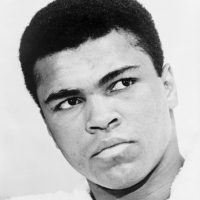
Evening Standard (October 1971)
Muhammad Ali, stretched horizontally across the three first-class seats of the train compartment, was either asleep bored or riding on this Ali Special from Euston to Manchester.
Momentarily Ali allowed his eyelids to flicker the tiniest, meanest gesture of welcome, before settling back into the repose of the unconscious. The gentleman who had organised our meeting made some final request that I make it quick, rather as one may ask a hangman to spare the condemned the misery of time, and left us alone.
Muhammad made no sign of waking up to be interviewed. He was off to preach the virtues of Ovaltine to the people of the North and he probably thought he needed his energy for that. Or maybe the rigours of the Nigerian tour he had just completed had been too much for him. Touring Nigeria the Ali way can be very vigorous, they tell me. At any rate, he clearly wasn’t prepared to waste more than the minimal amount of energy on me.
Even General Gowan, political leader of Nigeria, had short shrift from Muhammad. ‘I used to do some boxing,’ said Gowon conversationally. ‘What did you box?’ asked Ali. ‘Apples or oranges?’
Anyway, here I am, with Ali, wondering what he did with the charisma this morning, puzzling about how to even get him to notice that I’m there, and finally, settling for the sleep talker that he turned out to be.
Now thirty, and technically, I suppose, the former heavy-weight champion of the world, he’d still be as pretty as he delighted in telling us all those years ago, if he weren’t so fat around the face these days. But pretty or not, champ or deposed, he remains the super-hero.
To me, boxing is the most bestial of pursuits, and the idea of two heavies clouting each other daft before a crowd of blood-hunters does nothing for my ideas about the innate nobility of man. But with Ali, boxing became almost a sport. Where Sonny Liston or Joe Frazier’s methods were to hack, hack and hack away, rather like a man felling a Giant Redwood, Ali turned boxing into a game of evasion. His idea was not to get hit, and his best moments, for me, were when he was wriggling himself out of some disastrous position against the ropes, or playing tick and pat-a-cake with sixteen-stone leviathans.
Ali was the hero: the cowboy in a white hat who would beat all the bullies, the man who was prepared to resist the draft before it became fashionable – ‘I ain’t got nothin’ against them Vietcong,’ he said, (but who really expected that the Pentagon would have been so inept in its public relations as to make Ali a martyr by sending him as fodder to Vietnam); and the man who was finally canonised by the people when the sportsmen of Madison Square Garden stripped him of his title. He became a hero because he was an individual.
And here I am now, sitting with this super-hero. And being polite and all that, the way you are with super-heroes. And wondering how in hell to wake him up.
Best, I think, to start off with some elementary stuff about boxing, and, like a man feeding a juke box with a shilling, I put a simple, straightforward questions and wait for the record to start spinning its answer.
‘Was Joe Frazier always as inarticulate as he is now?’ I joked (unkindly and wrongly, I admit now).
Ali, neat in his pale blue shirt, dark grey suit and with his calf high boots neatly to attention on the floor beside me, remains motionless. And I wait, until eventually his larynx reaches down for some reserves of strength and the music begins to play.
‘Naw. He was always like that. And one mo’ thing, too. He’s ugly.’
‘I heard he may never fight again.’
‘Yeah, I heard that, too. But I hope he’s all right. I know I have him a good whupping but I hope I didn’t whup him that bad.’
Thinking I’ve heard this tune before, I try for another song, and push home another coin into the soporific Wurlitzer.
Would he ever like any of his children to become boxers?
‘Nah. Doctors, lawyers, scientists, engineers. Never boxers. For me boxing was the best thing I could have done. It was the only way I could get rich. But if I could, I’d have been a great doctor or something like that.’
What will he do after he retires, which he’s promised to do after he regains his title, which will, he thinks, probably be sometime next year.
‘I’ll stay at home, and mow the lawns and spend some time with my family. I’m really tired of fighting, of being a boxer.
‘I’ll retire from the ring and dedicate my life to the freedom of the negroes in America. That’s a great job. I’m a Muslim minister and I’ll go round converting them to Elijah Muhammad. I’ll unite them, and free them mentally. We have to build a whole nation for ourselves. A separate nation. We can’t live with white Americans. It’s impossible. The cultures are too different. We’ve been there six hundred years and it’s time enough to know that we can’t live together. We wanna be free from the white man.’
‘But are you not playing the “white man’s game” by getting up there and fighting another black man in the ring for the white man’s profit?’
‘Nah. We git money, too. And I can use it as a platform to convert the people.
‘I don’t hate the white man. I know the white man. I don’t hate snakes and tigers because I know them. But their natures are different, and so is their singing and dancing. Some white people can’t live together. Some White Russians can’t live with Jewish Russians. White Englishman can’t live with white Turks. White Scotchmens can’t live with white Dutchmens. Black men don’t want to be with nobody but ourselves.’
Wasn’t he very frightened when he refused to be drafted?
‘No. I was frightened of God if I did join the army. I don’t fear no man. But I think the man who goes to war should be more frightened than the man who goes to jail. In jail he eats and sleeps. He dies in war. That makes sense, don’t it? I have a poem about it. Goes like this:
“Better far from all I see
To die fighting to be free
What more fitting end could be.
Better surely than in bed
Where in broken health I’m led
Lingering until I’m dead.
Etc.
Etc.”
‘Did you write that by yourself?’
‘I’m not only a great boxer. I’m a genius. I ain’t just a dumb negro boxer. I’m a great writer, too. I’ve got lots more. It’s all being published soon. The biggest book in the history of publishing.’
I turn to the question of money.
‘Well I’m worth about two million dollars right now. I always stay in big suites.’
‘Frazier stayed in a little hotel room when he was here.’
‘Maybe he’s wise. Maybe he’s saving it for the winter. Big suites don’t mean nothin’. Right now I’m investing in real estate. It’s the only way.’
At that moment I was interrupted. ‘Would you mind …?’ asked one of the gentlemen promoters. I would, but what was the point?
For a fraction of a second, Ali’s eyes opened a mere slit, enough for him to lift his arm, and reach hold of my hand, in a dismissal shake.
When we got off the train at Manchester, I purposely mingled with the welcoming crowd to see whether Ali would betray the fact that he had been peeping during our chat and betray some recognition when he saw me. He didn’t. I stood right in front of him, and he smiled as though meeting me for the first time, anxious to wear the right public face.
