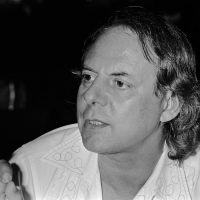
Evening Standard, September 1971
I’m sitting in the Albert Hall which, apart from a cluster of technicians around the platform, two pianists and a disembodied Germanic voice that seems to be drifting down from heaven with instructions, is quite empty.
The two pianists sit facing each other at opposite sides of the platform. They are playing chromatic scales, but again and again they have to repeat the exercise as again and again they are stopped short by the unseen German calling from somewhere up in the gods.
First the left-hand piano is too strong: microphones and screens are shifted, knobs are twiddled. And then there is the same trouble with the pianist on the right. To me the music sounds exactly the same every time the two pianists play. But to the ear of Karlheinz Stockhausen, that ear which he describes dismissively as a mere microphone, every scale is different in balance. To him, acoustics take on a whole new universe of meaning.
“I have intuitive visions of sound,” he says. “And when I deal with them they organise themselves. They respond very well to me, and I to them.”
Stockhausen, now 41, remains possibly the most unbridled prophet of the new world of music: a revolutionary of the avant-garde. Those who don’t understand his music, and there are many, hear his work only as noise. The use of the electronic devices, and the inclusion of the chance sounds to come from a transistor radio used at the beginning of one of his pieces, puzzled his early critics.
But now he’s moving on into an almost mystical belief in his own contribution: “I am not making my music,” he says, “but transcribing the vibrations that I receive.
“What I mean by that,” he told me after rehearsals had been concluded to his eventual satisfaction, “is that I cannot have any intuitive flashes unless I get vibrations from other people, and also from patterns of sound waves from outer space. When I compose I realise that I cannot explain my most important intuitive insights.
“For instance, I cannot explain why I wrote the piece I am composing at the moment. Psychological analysis would be a chain which would lose itself. It’s far more realistic to live with the daily experience that there’s a completely organised spiritual activity acting through me. And all that is important is that I am able to materialise it. Ultimately the music is already there.”
In short, he regards himself as a radio receiver, transcribing the vibrations he receives.
Stockhausen was born in a small German village where his father was the local schoolmaster. His early life was traumatic.
His father was a member of the Nazi Party and Karlheinz was expected to help in collecting the village funds, but he remembers now how his father faced inner conflicts when friends who were known socialist sympathisers were imprisoned by the Gestapo.
When Stockhausen was very young he was put into a special school – because of his “obvious intelligence and physical appearance”, he says. His mother had by this time been committed to an asylum for the insane.
“My mother was taken away from us when I was four years old. She must have been a very talented person because her parents bought her a piano, which for people from her background was most unusual. Then when I was 13 I came home for a holiday from school to see my father who was on leave, and he told me that she had been killed. They used to kill people who were in institutions for the mentally ill because food was so scarce during the war.
“They asked us whether we wanted the ashes but we decided not to have them. I remember I was not very shocked at the time. That’s just my way. I took it as just being sent. It was a challenge for me.
“The more that was taken away from me the stronger I became, until I was completely on my own and had nothing. I think that because both my parents are dead they support me much more than they could if they were alive. I remember I saw my father for the last time in 1945 during his last leave. He was killed just before the end of the war.”
During this time Stockhausen was attending a military academy, where the timetable was governed by the blowing of a bugle, and where every finger nail was controlled. Sport was of paramount importance, and privacy non-existent.
At the end of the war he worked in a military hospital, as he was too young to fight. The experience was unforgettable, he says. He watched thousands of men die.
Music has always been with him. In school he learned to play several instruments and then in the hospital he would entertain the soldiers by playing their requests for them – “from jazz to Beethoven, to a vulgar peasant song”.
“I remember how I stunned everybody because having heard a tune only once on the radio I could immediately sit down and play it with all the right harmonies. I never had to work for this. It was just there from being six or seven. I have six children now, and I notice how one of them has perfect pitch and can play and imitate immediately.
“I work very hard all the time, and I’m always trying to explore new possibilities.
“I think we’re living in a time when people who are extraordinarily devoted to their talent are decreasing in number and are being attached everywhere. There is not much place for a lot of extraordinarily talented people, because the general tendency is to cut off the peaks of the mountains and not to accept that there are natural differences. Now my greatest pleasure is to sit for 10 to 12 hours at a time and compose.
“The attitude is that because you have two ears you have the same right to judge music as anyone else. And that is not true at all. Being musical is something very special. It has been computed that only one person in a thousand is musical.”
He considers sounds as others consider sights. “Everything is visual in our society,” he says, and we have very few words to describe different kinds of sounds, other than words which we borrow from the visual.
“Because our whole reality is visual, our acoustic ability has decreased. All the time now everyone is talking about the design of the environment – about what you can see. But the acoustics – even the sounds you hear in the streets are taken as quite normal.
“If the visual world were so full of garbage as the acoustic world is full of acoustical garbage the people would just protest all the time. Which just shows that most of the people are acoustically deaf, and don’t even notice the acoustic pollution of the world.”
He broke out from the confines of the established musical study when he was 23, and studying music at the conservatory in Cologne. He performed an original piece in public and was immediately attacked by his professor for it. “I remember saying to him that he was trying to see a chicken in an abstract painting,” he says.
He believes in continued work as the essential method for continually being creative. Laziness, he thinks, leads to a negative process, and he lives alone now that he might be able to work more easily. When he asks himself “why me?”, which he does all the time, he invariably comes up with the answer that he must have been chosen by the divine spirit of the universe – the spirit of the total being. A devout and practising Catholic until 10 years ago, he left the Church, when he fell in love with another woman while married.
While we’ve been together we’ve been having lunch, with Stockhausen going into a marathon talking session. Suddenly he says something which occurred to him only that morning: “I thought this morning I heard the sentence in me ‘liking is remembering.’ When you like something you are not aware of the fact that you have been that thing already before.
“For instance, I respond very positively to certain birds – particularly eagles. And now I know from my experiences in dreams that at some time in a past life I have been a bird of that particular kind, because I know exactly the feeling of flying and living in the body of that bird..”
Karlheinz Stockhausen, the musical genius who has so influenced so much of today’s progressive rock and contemporary classical music, remains a man of controversy.
