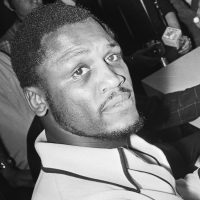
Evening Standard, June 1971
Right on 6.30 yesterday evening, just three weeks after negotiations for our meeting were begun and ten days after I first tried to interview him, Joe Frazier, naked from the waist up, came lumbering out of his hotel bathroom, yawned and stretched so wide that I momentarily wondered whether the room was big enough for both of us, and hurled himself down across his bed like a jumbo jet doing a belly flop landing. King Kong himself couldn’t have made a more impressive entrance.
We all know that Joe Frazier, the heavyweight boxing champion of the world, is a big man, but it is not until you actually find yourself gaping at the width and depth of that barrel chest that you begin to realise what bigness means in his league. At five feet eleven he isn’t a tall man, but no tank was ever built on so solid a chassis.
‘I recall the time when people said to me I’d never be champ,’ he says. ‘They said I was too short, my arms wasn’t long enough and that I didn’t have the punch to put those big fellow away. But I proved it to them. I did it. And now I’m gonna prove that I’m a singer too.’
Touring Europe with his own show as a soul singer, Joe and his group, the Knockouts, have not met with an overwhelming display of enthusiasm. In fact, the truth is that although there have been some full houses, an awful lot of their appearances have been notable for the lack of public interest and for the bad critical notices in the newspapers. He may be world champion boxer but his appeal has strict limits: he took Ali’s crown but none of his charisma.
Poor Joe can’t understand it. He knows he’s not as bad as they say he is so why do reporters write such lies, he asks, with a gentle, warming innocence.
‘Why do they say such things like “the champ can’t perform”? All the time I’ve been in the ring I’ve never done or said anything to hurt anyone, and now day after day these cats are throwing rocks at me in the papers. I mean there are all those bad guys in the world going around doing bad things but they don’t get the bad publicity I do. And I know there ain’t one other athlete done as well as me in entertainment. It really takes a champ to stomach it all sometimes.’
He’s such a friendly, guileless, wounded man that you wonder where he got his image as ‘Smoking Joe the killer tiger’, or from where he ever summons the necessary aggression to turn himself into a fighting machine. Yet, as he lies there, alternately thumping each titanic fist into the opposing palm, it’s impossible to remain unaware of his enormous potency for destruction.
‘I’ve never fought out of the ring since I was a boy,’ he says. ‘Sometimes some guy will come and punch me in the tummy or challenge me, but I just try to walk away, because if I hit him I’d probably hurt him. And I don’t wanna do that. I’ve never been a violent man.’
He was born the youngest of thirteen children to a poor South Carolina family.
‘My father only had one arm on account of how they had to amputate one after a car crash, so as a boy I was always my daddy’s left hand. He was really a hustler. I mean he’d cut wood, or chop cotton or be a junk man, collecting old cars and cutting up the metal. I was his baby and he took me everywhere, and consequently I was like a mature man by the time I was thirteen.
‘For my daddy I never could do no wrong. Momma would go fussin’ and give him the devil and say he was ruining me, but he didn’t mind. And I never took advantage. He taught me to be a good man and a strong man. He passed away in ’65. He knew I was fighting but he never got the chance to see me as big as I am today. I wish he could have lived to enjoy himself and have some fun. I’d like to have shown him what living is really like – and to have shared the things I enjoy doing with him.’
He talks very softly and with a slight nasal intonation, caused no doubt by the flattened, scarred nose. He is affable and pleasant, quite unlike his surly image.
‘I’ve always been singing. I’m a Baptist and I was in the church choir. My daddy and me would sing always when we were working together. When I was fourteen I volunteered for the army, but I flunked the tests. They give you all those blocks and squares and rangle-tangle triangles, and I couldn’t do all of them. In ’64 they passed me 1-A but by then I had a growing family, so I didn’t have to go.’
At fifteen he married Florence, a distant relative who was two years older than him, and they moved first to New York and then on to Philadelphia where he worked butchering cows in an abattoir. Then at sixteen he took up boxing because he wanted to lose weight, and soon found that he could make a good living out of it.
‘No, I never feel any pity for any man I beat. But I respect any man who signs that contract to fight me, because he knows I’m gonna go out there to take him apart. When I punch a fellow and see him crumble from the power of my hands and fall on to his back I feel great excitement. There’s a great thrill to it. But you don’t become champ by misusing yourself, by drinking and smoking and chasing after women. I’ve never done that. What I’ve got I’ve had to work for.’
He’s a strange old-fashioned figure with a rather touching regard for respect and chastening virtues of honest labour and in the couple of hours or so I spent with him, he neither criticised anyone else nor uttered anything which might have been considered profane. He is truly the gentle giant, the twenty-seven-year-old father of five who is looking forward to getting home so that he can keep the kids out of mischief during the summer holiday, go riding on his Harley Davidson motorcycle with his friends and get back to more regular training.
He believes in a rigorous, Spartan schedule, and at six o’clock yesterday morning, after driving back from a performance in Wakefield through the night, he decided to change into his track suit and go for a run right round Hyde Park – ‘You know, past that statue of some king or something you have over there’.
In America he was accused before his victory over Ali last March of behaving with toe-scraping humility, but I see no sign of it, just an honest, if possibly narrow, view of his own surroundings.
‘People ask me why I don’t help with the Civil Rights movement. Well, to be honest I really don’t understand all the details involved. I’ll help with money where I can, but before stepping into something like that you have to know more about it so you don’t get involved with the law or go upsetting black or white brothers. Nobody in my family has ever been in a movement of any kind. We’re not politicians and just because I’m champion of the world I don’t think it’s right that I should get up and start talking about things I know nothing about. Why should I make a fool of myself?’
For a man who was reputed to have been paid more than £1,000,000 for his one fight this year he is not living in any kind of grand style in London. His hotel room is small, almost poky, although it is in a new luxury block, and is littered with suitcases from which the contents are trailing in all directions. Under a contract to a syndicate called Cloverlay in Philadelphia, the percentage he keeps of his earnings is a well kept secret. Still he reckons that with his investments he will have enough to live on for the rest of his life.
‘The most exciting thing I ever knew was to realise that I could have all I wanted and live a comfortable life. That was my dream when I was young. I didn’t want to live like daddy and mom. I understand that they didn’t have the opportunity, but they did for me what they did and I’m gonna do better for my kids. They’re all musical so maybe we’ll be a family of entertainers.’
But first he has to prove himself an entertainer, and no amount of setbacks are going to stop him, he says. He’ll just go on and on and in three years when he retires from the ring, he’ll become a full time singer.
But when will he fight next? ‘I don’t know. I might even challenge you next. What d’you say?’
POSTSCRIPT They say that boxers and writers always get on well together, and although I had always been an Ali fan I found myself drawn to Frazier because of his basic niceness. I was pleased when he retired, because I suspect that his second fight with Ali did them both terrible harm. Of course he never did prove himself as a singer. He couldn’t sing.
