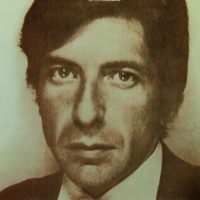
Evening Standard, July 1968
Leonard Cohen is a poet, and a singer, and a novelist. And in a romantically ethereal and almost mystical sense, a gipsy too. In America concert promoters and television producers clamour to pay him thousands of dollars a night but he doesn’t work very often and his manager is distraught at the lost opportunities.
“Money has never been an issue with me,” he says, throwing a careless arm towards the shabby leather bag in which he carries his belongings. “I came here with what I stand up in,” and that must have caused some raised eyebrows at the expensive Mayfair hotel to which his record company treated him during his visit.
He was born in Montreal in 1934 in a family which built, and were apparently pillars of, synagogues, and which had a sense of being destined to lead the Jewish people of Montreal. Before he was very old, he says, he was quite convinced that he was at least the direct descendent of Aaron, the high priest, and had a mystical destiny.
“We weren’t a lavish family, but we must have been quite well off, and I grew up like the Queen believing it was unnecessary to concern myself with the making of money.”
After taking his BA at McGill University he went to Columbia in New York, but was asked to leave when he did a term paper dissertation on his own first book of poems, because it was the only book he had read.
He began writing poetry because he thought it was one of those things that men did as part of the courting process. “I must have looked extremely absurd because I wrote all my poems to ladies thinking that was the way to approach them.
“Anyway, for some reason or other, I put them all together in a book and I was suddenly taken seriously as a poet, when all I was really was a kind of stud – not a very successful one either, because the successful ones don’t have to write poems to make girls.”
He had temperatures of poetry with which to woo the ladies. At the beginning of the courtship he would write:
As the mist leaves no scar
On the dark green hill,
So my body leaves no scar
On you or ever will.
But when he wanted to inflame his love he would write more blatantly … much more blatantly.
He’s a small man in those dark serviceable shirts and slacks that Americans wear so much, and his face is strong and heavy. When he does a concert (and he’s taped two this week for BBC television) his great soft eyes tell his sad stories for him and he looks at once vulnerable and yet self-contained.
He is, he feels, a romantic, and a lecher and a lover of women. “Women,” he says, “are indeed in control. It isn’t necessary to declare a matriarchy but it exists just the same. Everything that a man does is laid at a lady’s feet whether it is a battle or a song, or an amalgamation between two great companies. At some time in the day the man comes home to his woman and says ‘look what I’ve done’.
“I remember one day I was in a very exalted state and I saw a bunch of cows in a field. And I noticed how beautiful they were that I got down on my knees to worship them. And, do you know, those cows were so happy. The more I worshipped them the happier they became. And to make a metaphor out of it, it’s exactly the same with ladies.”
Cohen’s lady is a Norwegian girl called Marianne who lives with him on the Greek island of Hydra. He met her one day when he was sitting outside a store and thought she was the most beautiful woman he’d ever seen.
“She had a three-month-old child and her husband had just fallen in love with an American girl. So I went to him and said if he went off with the other girl I would like to go and live with Marianne. We had a lot of drinks together and talked about it and everything worked out all right.”
The child is now eight and at Summerhill School, and Marianne has learned to accept his need for other women.
“She knows that is what my nature is. I say to her ‘what are your appetites,’ and she knows what I mean because she’s attracted to other men. And I know she’s had that feeling.” He wrote his most successful novel Beautiful Losers, while living in Hydra. He had been staying in a Hampstead room and it kept raining, so he went off to Greece to write. The book sold 350,000 copies in paperback form in America but he couldn’t get it published in Britain because it was considered too obscene for anyone to handle.
“They didn’t realise that I wasn’t turning people on to sex but putting it down,” he says.
But it is in his poetry and his singing (“my songs are poems with a guitar behind them”) that his impact has been fullest. He’s a very measured and lyrical writer which seems curiously unfashionable against the unpunctuated rat-ta-ta-tat of modern verse and there’s an unremitting sense of despair about his lines. When he sings his tone is of a basser Gene Kelly, but he’s manly and melodic and seems in a perpetual private agony.
His first album was hugely successful in America (particularly on the campus belt) and his song Suzanne provided a totally unlikely hit for Noel Harrison (Man from U.N.C.L.E) possibly because it required no great singing effort to perform.
“Suzanne is about a girl I know. She’s great but she’s half crazy. And the other week I was in New York or Los Angeles or somewhere and a guy came up to me and said he liked my song and that he’d lived with Suzanne for a while. And I asked him if he was still with her. And he said no he couldn’t stand it any more. The girl was half crazy.”
