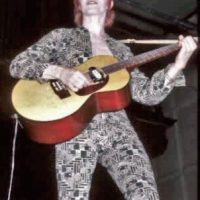
Evening Standard, February 1973
The singularly most interesting aspect of the development of pop in the last couple of years has had less to do with the music being played than with the presentation of that music. And when it comes to stage acts Bowie is both the best and the most original.
Where Mick Jagger once pampered and teased his audience with the hint of something we used to call unisex, Bowie now treats us to a full-blown parade of sexual ambiguity, complete with make-up, dyed hair bright red and the exaggerated pouts and facial expressions of the mime artist.
The effect he creates is startling – not least, I suspect, because he dares to flout so deliberately the time-honoured law of pop music that rock idols had to appeal to the heterosexual desires of the females in the audience on the one hand, and to be objects with which the boys might identify on the other.
‘I’ve never considered myself anything to do with transvestites or drag acts,’ he told me this week. ‘I think what I’ve done on stage is to create a kind of neuter state. It isn’t unisex either, but it does incorporate both masculine and feminine aspects of sexuality. I think androgynous is the best word to describe us.’
Is he homosexual?
‘No … I’m bisexual. I first realised it when I was about thirteen or fourteen.’
Was he frightened of public scorn when he first realised he was bisexual?
‘No. I was more frightened of football. That makes me sound really fey doesn’t it? Well actually I was bemused by it. I suppose I’ve always been an outsider.’
He was brought up in Brixton where his father was a public relations man for Dr Barnardo’s Homes. After an education at a technical school he joined an advertising agency as a junior visualiser, playing saxophone in the evenings.
‘I only had the job for about six months, because I found I was much better at playing saxophone than selling gabardine macs. I’d already begun to play the guitar a little, but I got tired of playing other people’s material and began to write my own.’
By the time he was nineteen he was supporting himself as a full-time musician, having also been through a period working with a mime company. That, he says, was where he learned a lot of his stage craft, forming his own three-piece group called Feathers, which performed mime, dance, poetry and song. Then in 1969 he had his first hit album ‘Space Oddity.’
‘I suppose I was inspired by the newspaper malarkey about space shots and all that. It just sort of oozed out. There’s never any heavy thought behind much of my material. It just finds its way out. I have very few preconceived ideas about what I’m going to write.
‘Really I’ve always felt like a public warning about what’s going to happen. That’s how I consider myself. If you come right up to date I find that I wrote a lot of songs in America and now when I look at them the strongest thing to come out is the superficiality and decadence which surrounds the rock business at the moment. It seems to me that the kind of feeling generally heralds the coming of some kind of catastrophe – notably wars. I wouldn’t say that was a strong theme going through my next album but it’s definitely there.’
Now twenty-six, he’s married to an American girl called Angie and they have a little boy of eighteen months, Zowie Bowie.
‘Angie’s a writer,’ he says. ‘She writes theses. At the moment she’s writing one on the effects of extra-terrestrials on the human make-up. I haven’t read any of it yet because she’s in Detroit. We met at a dancing club about three years ago, and were married after about three months. Yes, it was quite quick. The main reason for getting married was that she was about to be slung out of the country. It was a good idea at the time. It seemed to be the only way to keep her here. It’s still a good idea. There’s not much I can say about Angie. We spend about fifty per cent of our time together and about fifty per cent apart. No, the absences don’t bother her. She travels, too.’
Why did he wear eye make-up, I wondered, noticing that his lids were heavy with a brightly coloured stage eye-shadow, although he wasn’t performing that day.
‘I’ve always worn make-up. I first began to fool around with it years ago when I was a mod. I was a very heavy mod, and I used to wear ankle swingers (white jeans that only reached the bottom of his calves) and luminous socks. I always wore Clearisil and eye-shadow then and I’ve never got out of it.
‘Really I like to change my appearance a lot. Oh yes, sure it’s narcissistic. My hair has been a variety of colours but I’ve settled on red over the last year. Really it’s a kind of blond colour. Fortunately it takes dyes well.
‘Make-up isn’t a new thing particularly. Elvis wore make-up, although the difference then was that we didn’t know it. I think it became inevitable because of the indifference there is to long hair these days. I mean I think the only possible shock factor to emerge was that guys would begin to wear make-up. I suppose I knew that years ago because I’ve always been involved with shock tactics.’
Why did he think that audiences could identify with him so much?
‘Well, I think they believe I’m a very truthful person. I’ve always been very honest in my approach to things. And because of that they know that they’re safe with me as an artist because I’m not going out of my way to hype them too much. What I try to do is to fantasise for them, because that was one of the main things I got out of any kind of entertainment and theatre when I was young.’
What did he think of the cult that’s grown up around him, and the other rock music acts copying his sexual ambiguity?
‘Well, they’re all part of the great misconception. It worries me because I wonder why all the other bands are doing it. I really don’t think they know why I do it. I am, I think, open to a greater degree of sensitivity, and this illustrates itself in my performance.
‘You see, a lot of my performance comes from the mime thing I went through. The mime artist will wear a white face so that any movement he shows on his face will become accentuated – he doubles the intensity. And as a writer and artist I try to mirror sensitivity.
‘People like to call what I do “glam-rock” or “rock-and-rouge”.’
Wasn’t it difficult being the first major rock star to admit to being bisexual?
‘No,’ he said. ‘Although I’m glad you qualified what you said with the word “admit” – because there have been lots of others and I’ve got names to prove it.’
Does he ever find that he’s becoming a figurehead for Gay Lib?
‘Well I think the Gay Lib people understand me, and I understand them very much, and I have a lot of sympathy of sorts for them. But being an independent I haven’t found a need for group therapy as such, or group togetherness to fight a cause. I don’t want to represent Gay Lib – I know too little about them, although I do know a number of people who are members and as people I find them very charming. But they attract an awful lot of ridicule, which is hard because a lot of them have to hold down very straight jobs.
‘I think being bisexual is a facet of my life, but not necessarily the most important. It certainly isn’t my foundation by any means. In the States it gets into horrendous proportions and it’s “fag-this” and “fag-that” and all the papers call me a “fag” – which is lovely.
‘But I don’t see why it should stop me from being an all-round entertainer. I am an all-round entertainer. My mother comes and sees us, and watches us on the telly and she loves us.’
