Daily Mail 7.11.15
We take our childhood with us when we grow up. It’s impossible to leave it behind. And then, for better or worse, we carry it with us for the rest of our lives, a constant reminder of who and what made us the person we became.
For Colin Welland, the actor and writer who died this week, aged 82, his childhood was an unashamedly rich source of strength and inspiration, a solid working class foundation of family and education on which he built his life and his career.
And some years ago I spent an afternoon interviewing him as he conjured up images of his childhood, of Sunday afternoons going to see his grandfather where the men in the family would discuss Labour Party politics, and his parents struggle to give him and his sister a better future.
He was born, Colin Williams (Welland being his stage name) in 1934, living in Liverpool where his father was a crane driver on the docks and his mother worked as a helper in a hospital. He had one sister, Beryl, who was four years older.
‘I don’t remember much about the pre-war years,’ he told me, ‘perhaps because the blitz was so vivid, everything that happened before was washed out. I do know I was never frightened by the bombing, which was amazing because houses were being annihilated around us all the time. I suppose, my parents protected me and my sister by keeping anxiety away from us.
‘The only apprehension I had was looking for paratroopers because we were told we were in imminent danger of being invaded and they would be the first sign. My father built an Anderson Shelter in the garden. You had to dig your ditch. The lucky ones didn’t get water in. Ours didn’t, and my dad concreted the floor, and put in an electric light, bunks, a radio and sandbags by the door to stop the blast if a bomb fell nearby. Every night during May 1941 the family slept in the shelter as Liverpool was bombed.
‘I can hear the planes now. You could tell the German ones because they had different sounding engines. It was all a thrill for us. During the day we used to have the classroom in our front room at home because we didn’t go to school during that period, and they would bring the classes to people’s houses.
‘Every morning we’d get up and see whose house had gone. There was a family down the road and they’d been in the shelter. Their dad was coming home from his shift at ten o’clock. But the bombing began at eight, and the mum said to the kids ‘you stay here in the shelter and I’ll go and put your dad’s dinner on’. But they didn’t want to stay by themselves. So they went with her, and while they were in the house there was a direct hit on the shelter.
‘It was a huge crater and the family stood at the gate and you’d pay sixpence to go and look at the damage. That was a way of giving to tide over the people who had been bombed out.
‘Then we’d collect shrapnel going round the streets picking up bits of shells and swopping them between ourselves. The best were the bits with German markings. British stuff you could get anywhere. I remember a time at school when they raffled a blackened banana for a Spitfire. I didn’t know what a banana was until then.’
In 1941 the family moved 18 miles to Newton-le-Willows, near Warrington, when his father, ‘who was always adventurous’, got a new job at the American air base at Burtonwood, inspecting the parts of aeroplanes that had been shipped from the US for assembly in Britain.
‘It was very different, a small, close-knit community where everybody knew everybody else,’ he remembered. And it was there that he met coal miners for the first time.
‘Golborne, where I went to school, was a mining village, and the miners used to squat at the bus stop. They’d never stand anywhere because they were so used to squatting underground. Those were the days before pit-head baths, so they’d go home all black, with little pink mouths and pink eyes, their helmets on the back of their heads, their clogs on their feet.
‘They’d all sit on the top deck of the bus and you’d hear their clogs on the ceiling above you. Then you’d look up at the mirror to the top deck and it would be just filled with smoke.
‘Kids wore clogs, too, which they never did in Liverpool. I wanted some, because you could slide in the playground and kick sparks, but my mother wouldn’t let me have any because she thought they were common. She was a bit of a snob.
‘When a teacher ridiculed me because I had a Scouse accent when we first went there, my mother was up there at the school, sleeves rolled up, like a bloody shot. She wasn’t going to have some upstart common teacher ridiculing the way her boy spoke.’
He was soon to modify his accent to the flat Lancashire dialect he kept for life. But it was in Newton-le-Willows that he first met Americans when they were off-base, memories he would use decades later in his screenplay for the film Yanks.
‘I wouldn’t say they invaded Newton-le-Willows, but they did make the cricket club a place where no respectable person would ever go. Warrington was like Dodge City. We used to go to the Royal Court Theatre there every Friday night and coming back to the bus stop was terrifying. They were all drunk with knives… and all sorts.
‘It was a horrible place at the time. But it had its lighter moments because kids are like hyenas, scavengers, and they always make the best out of everything. So, on the fringes of the G.I.s we had a lot of fun, doing the ‘fish and chip run’ for the soldiers who couldn’t leave camp, for instance. And the Americans were very kind to us.
‘I’ll never forget seeing my first Yanks. They weren’t soldiers, they were engineers who’d come to build the base, and they were strutting down Warrington High Street wearing stetsons and cowboy boots. Can you imagine that! Warrington hadn’t been invaded by anyone since the Romans and suddenly there they were.’
Always, though, his parents made the biggest impression on him, his father remaining something of a hero to him all his life. ‘He was a restless man,’ he recalled, ‘who had ambitions which were regarded as ridiculous for an ordinary working man in Lancashire, a pioneering type of bloke who was stuck in a council house in Newton-le-Willows. He’d been round the world as a merchant seaman at sixteen.
‘At one point he wanted to open a launderette before they were known here, and everyone laughed at him and said no one will want wash their dirty linen in public. So he couldn’t get any financial support.
‘His most ambitious project, though, was his flying bike. He was fascinated by the idea of man-powered flight and brought two pigeons home one day and measured their wing expanse in relation to their body weight. Then he constructed a flying machine of metal and had me suspended in our washhouse pedalling like hell on a spring weighing machine There were great big propellers going round on either side of me as he measured how much I lessened my weight by pedalling.
‘But it was only theory. He never had the necessary lightweight materials and it didn’t fly. Of course when I told the kids at school that my dad had a flying bike it became totally a subject of ridicule.’
His father may never have been able to afford very much, but they weren’t poor. ‘Poverty is relative. I never felt poor. We were an average family in that we had as much or as little as everyone else around us. I remember one Christmas when I wanted a low-slung, flashy racing bike like some of my friends, and I remember my dad took his bike to pieces and re-assembled with low slung handle-bars.
‘It wasn’t the same, but even at that age, when you’re so self-centred, I was sensitive to what he’d done and I was very grateful.
‘If there were difficult times they were nearly always kept from the children. One time, though, after the war when my dad was very briefly unemployed and had gone down to Cambridge looking for work, a man came to the door and my mother had to sell her engagement ring. That was very traumatic for her because she had a little weep.’
His mother suffered from epilepsy, and he would see how his father would be extra-protective towards her. ‘I remember hearing terrible noises of my mother having an early morning fit. It was very frightening, although we got used to seeing it. But it was always my dad who would be there first, who would get the cushion and put her on one side. It was a tremendous affection and he would buy her little gifts and send her telegrams when he was away.’
There wasn’t much money around for anyone after the war, but there were usually family holidays. ‘My parents had a tandem and they had a sidecar on the side for us children, so we’d see the world through its brown celluloid windows as we toured North Wales and stayed at Mrs Roberts b and b in Betws-y-Coed.’
He always loved cinema, his first memory of films seeing Merle Oberon as the ghost of Cathy at the window in Wuthering Heights. And from his primary school onwards, he realised he liked to entertain.
‘I must have been a right little bore. I was a boy soprano, so my mother entered me into the Heysham Head Talent Competition when we were on holiday at my Aunty Maud’s, and I sang Ave Maria and won a beautiful scouts knife. It was my first show business triumph.
‘Then on the same day a letter came to say I’d passed the scholarship to go to a grammar school, which was a big thing, because you didn’t want to be sent to a secondary modern. I rejoice in comprehensives now, but we didn’t have them then. So for a kid to pass the scholarship was important.
He took advantage of it, too, although not as an all rounder. ‘I was very good at English, history, geography and art, but physics, chemistry and maths were an absolute closed book. and I couldn’t be bothered doing the homework to learn Latin.
‘My parents didn’t pressurise me to do the homework. They should have done. But they weren’t readers. I’d loved all the Just William stories, but the only books in our house were for information, like encyclopaedias.
‘All the same school changed my life. When you lived in a little Lancashire town then practicality was the byword and my parents had had to fight for everything they had and security was the most important thing they could offer their children,
‘But when I was taught English by Flora Bannister, and heard her enthusing about Wordsworth and Browning and Dickens and was directed by her in school plays, I realised there were was a world beyond of excitement and emotion and lyricism that gave validity to my ambitions.’
In short, he loved ‘doing all the things for which I would win prizes later’, like athletics, the emotions of which he drew upon when he wrote the film for which he won an Oscar in 1981, Chariots Of Fire. But doing only what he enjoyed also meant that he left school without an O’Level in maths or Latin which decreed that he couldn’t go to university.
Instead he was called up for National Service, of which he said: ‘I hated every minute of it and found it the most abhorrent society that I’d ever had the misfortune to be placed in.’
His father died of lung cancer while he was in the army, and his sister two weeks later at the age of 24 of a rare blood disease. ‘It was a terrible double shock, and made me realise that we’re all mortal and everything can’t go on as it always had done.’
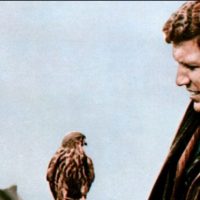
After the army he went to a teachers training college and then spent five years teaching art – which turned out to be invaluable experience for his role in the film Kes, for which he would win a BAFTA in 1969.
‘I’d hankered to go on the stage since school,’ he told me, ‘but it hadn’t seemed practicable. But after four years of teaching, I’d become my own man. I had the confidence to give it up and I eventually got place in rep in Manchester.
His wife, Pat, told him, ‘But you can’t act’, but she still backed him. ‘I couldn’t have done it, without her support, both practical and emotional. I had to give it a try.’
Two years later he was a regular in the nation’s long running favourite TV police series, Z-Cars. ‘And when that finished and I found myself out of work, it didn’t seem too overawing a situation for me to try my hand at writing.
‘But it was all due to the spirit that my father had fostered in me. He provided the environment that was necessary for me to become myself. He showed me that great pioneering spirit he had, which was never ever to be content with the particular moment, but to want to make a mark that could be lasting, and not to die forgotten.’
