Daily Mail, December 21.12.15
His leaving of the field he loved was not as dignified as Jimmy Hill might have wished. Shrouded in the fog of Alzheimer’s Disease, he was fortunate, perhaps, to have lain unaware as some of his five children from two earlier marriages squabbled publicly with his third wife, Bryony Hill, following the recent publication of her book about him.
The issues at stake were, it is said, the management of his assets and the care and treatment he was receiving at the West Sussex care home where he spent his final years, and where he died on Saturday, aged 87.
It was all so unseemly. As to who is right in the argument, none of us outside the family can say. Who knows what goes on in any family other than our own?
What we do know is that Jimmy Hill was an ordinary man, from an ordinary background, made extraordinary by virtue of his own energies, far-sightedness and capacity for hard work,
But also, it must be said, by the age he lived in, our age, which has seen the crumbling of class barriers in sport turn once working class football into the nation’s favourite game.
As a sporting visionary he was clever, and in many ways fortunate that his abilities in front of a TV camera coincided with the exponential growth of televised football. But, in no small measure, he was also responsible for at least some of that change.
Absolutely a product of his time, Hill, born the son of a milkman in 1928, was a South London grammar school boy who took the gifts endowed on him to the absolute limit. It’s been to football’s benefit, too, that while fashioning his career, he also helped drag English game into the second half of the Twentieth Century.
To the many who do not care for football, this achievement may not matter one jot. But for the many millions who do care, Jimmy Hill did matter. He helped make a difference.
Obviously football was the centre of his life, and for twenty five years, and over six hundred performances, he became the acceptable, wise face of the game on the BBC’s Match Of The Day. With his long, Habsburg jaw and jutting chin, exaggerated and made almost Mephistophelean by that defiant tuft of beard, he talked knowledgably in the Seventies to anything up to twenty million viewers, men and women alike.
Nor was he afraid to voice his options. He was a sports loving man through and through, complaining regularly about inept referees and cheating players and condemning fan hooliganism which he abhorred. All the rest, the egos and the violence, he would say, had no part in the game he’d loved since as a boy he’d watched Crystal Palace FC.
He was born in Balham, a suburb of South London, not a particularly smart place in which to grow up, and, after leaving school at sixteen, a short lived employment as a chimney sweep did not promise a sparkling career.
Nor did National Service seem to suggest that he was anything more than a young man of various talents with a burgeoning petty entrepreneurial spirit. As a clerk in the Royal Army Service Corps, he would iron squaddies uniforms for a small fee, teaching others how to use a typewriter.
The Army, however, must have seen something in him, because although his service career took him no further than the rank of corporal, his nascent leadership qualities meant he was considered as potential for officer training.
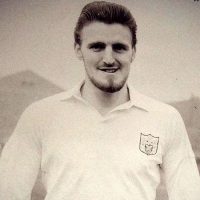
Football, of course, was his preferred career, and after a couple of seasons at lowly Brentford he moved to Fulham. Never a great player, he was a leggy, bearded, tall, forward, praised more for his effort in those Fifties days of pitches reduced to mud swamps by this time of the season.
It was an age before special diets for the players had been thought of, years when vast crowds of men and youths swayed as one as fans stood in often decrepit stands, and when results would be published in ‘football pinks’, as local evening newspapers would rush out extra editions on Saturday afternoons almost as soon as the referee’s whistle had blown for full time.
It was also the time when a player might still have to go home on the same bus as the fans – not a pleasant experience if he had played badly, and when the maximum wage for a professional footballer was set at twenty pounds a week, with perhaps a few extra fivers sipped surreptitiously into the odd football boot as a thank you by the often wealthy owners.
Twenty pounds a week for a working man wasn’t a bad wage in the mid- Fifties, but it wasn’t a fortune when there might regularly be well over fifty thousand fans in a ground. And it was an iniquity which young Jimmy Hill would change when in 1957 he was voted chairman of the Professional Footballers Association – the football players’ own trade union – and championed th end of the maximum wage.
He achieved his goal in 1961, when his much more talented Fulham teammate Johnny Haynes, became the first £100 a week player in Britain.
No doubt, years later, Hill must have shaken his head in wonder at the multi-million pound wages that some footballers began to demand when the game evolved into a globally televised bonanza.
But that had nothing to do with him. His fight had been for the ordinary footballer – young, overwhelmingly working class young men like himself, who were engaged in what was often a rather short career.
Not that he ever got more than twenty pounds a week as a footballer, himelf. Retiring from playing at 33, he went off to Coventry City as an innovative manager, where, pushing tradition aside, he championed an all-seater stadium, Press and TV interviews with players after a match, and successfully led Coventry from the Third Division to the First before quitting to move into television.
In purely football circles he was already well known, and he would later become chairman of Coventry City. But it was as a pundit on television that he became famous, when along with the entire Match Of The Day team, he found himself evangelising for football.
Until the football World Cup of 1966, football had been in the shadow of rugby, the sport of choice at public schools and self-regarding grammar schools who aped their ‘betters’. Now, through Hill, John Motson, David Coleman and others the working class game of football began its inexorable charge in popularity through the class barriers.
Articulate, and by virtue or otherwise, of his looks, an easily satirised figure, Hill became one of the best known television performers in the country. Nor did fame blunt his negotiating skills.
This was shown when, in the class ridden world which is horse racing, he sided with jockeys and the anonymous lads and young women who worked behind the glamorous, scenes, and helped set up the Stable Lads Association, their own trade union.
He had always been a natty dresser, luxuriating in good hotels and all the perks of recognition, even when football fans shouted ribald comments when they spotted him at matches. He enjoyed his fame, never more so than when, during a match between Liverpool and Arsenal he agreed to run the line when the linesman on duty pulled a muscle.
Only a qualified referee is allowed to do that, but of course, Jimmy Hill, ever the total enthusiast, was indeed a qualified referee, as well as having been a player, manager and football chairman.
He was also, he would admit in his autobiography, something of a ladies’ man, having married three times and had several long term affairs. Married first in 1950 while playing at Brentford, he and his wife Gloria had three children. Two children were the result of a second marriage.
He met Bryony Hill, his third wife, with whom he would love in East Sussex until his illness two years ago when she answered an advertisement in the Times for a PA for a BBC executive. It simply read: ‘BBC Sports Personality with a dog seeks a super-efficient PA.’ She got the job and the man. He was 49 and she was 25.
On television Jimmy Hill was considered a great communicator, but old age was not kind to him. And a Sunday morning programme on Sky came under repeated criticism for his rambling and loss of concentration until he retired in 2007.
He should have left years before. It is now believed that he was showing signs of dementia four years earlier, with Bryony Hill having been awarded power of attorney in 2005. Jamie Hill, Jimmy’s son, believes he and his siblings should have known about this at the time.
The last years of Jimmy Hill’s life were both sad and cruel, but his achievements had been immense. Like all of us, he had his faults and vanities, but bigger than those was his energy and determination. Not bad for a boy from Balham.
