Daily Mail – April, 2015
There has never been a popular song quite like it. For over forty years its lyrics have been an enigma wrapped in an eight and a half minute long, rock and roll puzzle.
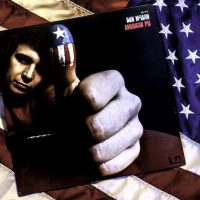
Argued over by generations of geeky fans, deciphered and re-deciphered by code-breaking rock nerds and considered to be poetic reflections on mid-century American social history by even groovier academics, it’s called American Pie.
And this week its lyrics, written in 1971 by a young folk singer called Don McLean, were sold at auction in New York for over a million dollars.
That’s a lot of money for eighteen sheets of paper. But I rather think that whoever bought them got a bargain. Because, in this age, when song lyrics have all but become meaningless,
American Pie illustrates, in a series of images, metaphors, headlines and allusions, just what can be done within the frame of a melodically straightforward pop song.
It’s also a paean to education. McLean loves words, he says, ‘almost as much as life’. That may be a slight overstatement, but it shows.
Of course, like all poets, McLean didn’t give us a key to the riddle of what his song was about when he released his multi-million selling single. That would have spoiled it.
‘It means I’ll never have to work again,’ he would joke, leaving us to work out for ourselves what the ‘sad news on the doorstep’ was exactly, and why he ‘couldn’t take one more step’ when he read it.
That was the easy part, of course, for anyone of my and his generation who learned about the death in a plane crash in 1959 of one of the first great singer-songwriters of rock, Buddy Holly, when we read about it in the morning newspaper.
I was on a Ribble bus going to school in Lancashire peering over the shoulder of the man sitting in front of me when I saw the headline. McClean, according to his song, anyway, was aged 14 and delivering newspapers himself in the rather smart New York suburb of New Rochelle where he grew up.
It was a strange, wistful opening for a pop song, but then, as the beat kicked in the lyrics began to portray the innocence of God fearing, teenage high school in Fifties America.
Listing pop song titles like The Book Of Love and A White Sports Coat And A Pink Carnation, and dances in the gym where the worst that could happen would be that the girl you fancied was dancing with some other guy, it painted a picture of what by 1971 was already a bye-gone time.
While in between every verse would come that cryptic chorus about driving his ‘Chevy to the levee but the levee was dry’. For years I thought that was something to do with the raised earth works – levees – that ran along the banks of the Mississippi in New Orleans; until I discovered that a levee can also mean a party.
So the parties that American kids would attend in the non-threatening Fifties would always have been dry – that is, without alcohol? Same here.
On the surface it might seem that American Pie, especially the first half, which was the section mainly played on the radio, because the record was far too long to be played in full –was just a misty eyed lament for an untroubled Mom and Apple Pie American youth.
But suddenly the mood of the song changes as McClean, jaundiced almost, certainly disappointed, looks around late Sixties America and see how the ‘jester in a coat he borrowed from James Dean’ (thought to mean Bob Dylan in his leather jacket) stole the King’s ‘thorny crown’. Or, as you and I might say, knocked Elvis Presley off his top notch perch.
Almost everything is seen through youth icons. In the lines ‘while Lenin read a book on Marx’, was he teasingly criticising John Lennon for appearing to be exposing Marxist revolutionary theory in his solo songs?
And was ‘helter skelter in a summer swelter’ a reference to the murders of actress Sharon Tate and friends by the ‘Charles Manson family’ in Los Angeles in the summer of 1969? It has to be. In an absurd defence, Manson maintained that he had interpreted the Beatles innocuous lyrics in their song Helter Skelter as instructions ‘to go out and kill’. He’s still in jail.
Even after all these years much of the song is still opaque. Was the reference to the Byrds’ record Eight Miles High a comment on the carpet bombing by US Air Force jets in the Vietnam War?
Only McLean knows and he isn’t saying. When asked to give a few hints as to the meaning of the lyrics for the auction catalogue, he simply said that ‘the song was not a parlour game’ but ‘an indescribable photograph of America that I tried to capture in words and music’.
And metaphor, he might have added, as, in my interpretation, a game of American football becomes a student demonstration, probably at Kent State University, to the music of the Beatles Sergeant Pepper’s Lonely Hearts Club Band album.
‘The halftime air was sweet-perfume’, which probably means that ‘everybody was smoking pot’, and wanting to have a nice, quiet time, when the demo was broken up violently and tragically by the Ohio National Guard.
Then there’s the question of Mick Jagger. Is he ‘Jack be nimble, Jack be quick, Jack Flash sat on a Candlestick’? Maybe. But it isn’t the Beatles last US show at Candlestick Park, San Francisco, that he’s singing about, but the Rolling Stones’ performance at nearby Altamont in 1969.
At that concert the Stones performed Sympathy For The Devil and then watched helplessly from the stage as before them in the crowd some Hells Angels beat a fan to death. ‘And as I watched him on the stage, my hands were clenched in firsts of rage,’ go the words, ‘No angel born in hell, could break that Satan’s spell.’
Dancing to rock and roll in the gym was never meant to get like this, he seems to be saying. I’m not sure that if I were Mick Jagger I’d want to hear that sung about myself.
Although McLean said before the auction that ‘the writing and the lyrics will divulge everything there is to divulge’ about this ‘mystical trip into my past’, they clearly don’t. But the catalogue did cast some light on how the song changed before he recorded it.
Originally he had intended a positive ending, suggesting in an extra verse that the music he had once loved would be reborn in happier times. But in the end he settled for the more worldly wise:
‘The three men I admire the most, the Father, Son and the Holy Ghost, They caught the last train for the coast, The day the music died.’
A bleak ending, yes, but apart from the reference to the Holy Trinity is there also a nod here to John F Kennedy, Robert Kennedy and Martin Luther King whose assassination occurred in the Sixties?
Again Mclean isn’t saying. What he does do, however, is give excellent advice to young songwriters who are just starting out on their careers: ‘Immerse yourself in beautiful music and beautiful lyrics and think about every word you say in a song’.
It seems so obvious doesn’t it, and then you turn on the radio, and realise that hardly anyone cares much about the precise words of songs anymore.
Most readers will probably think of Don McLean, who now lives in semi-retirement, and no doubt the lap of luxury, with his wife in Maine, as a one hit wonder. And he certainly wasn’t able to ever top American Pie.
But at around the same time he also wrote two other great pop classics. Vincent, which was about Vincent Van Gough’s painting The Starry Night, as well as And I Love Her So, which has been a hit for several other artists.
The buyer of the lyrics of American Pie unfortunately prefers to remain anonymous, and that suggests to me that’s he’s a billionaire who wants to frame them and stick them on his study wall, or worse.
I’d far rather they’d been bought by a rich American university so that students of American literature and social history could spend another forty odd years poring over them, and talking among themselves about what can be done with a popular song, and how America was, as it says in the lyrics, a ‘long, long time ago’.
