August 2014
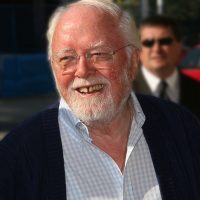
Among the great and the good Richard Attenborough was one of the best. Most readers will know him affectionately as the chubby, ever-optimistic film producer/director who exploded into tears when his film Gandhi won eight Oscars in 1982, giving him a Spitting Image image he bore with resigned amusement.
But beneath his public emotions there was a driven man. In a career of over sixty years, as he rarely stopped working he scarcely stopped giving either – whether it be money, and he would give away millions of pounds, or, even more generously, his time and efforts for causes in which he believed. And, as a lifelong socialist, there were many causes.
Once when asked why he chose to make the movies he did, films like Gandhi and the anti-apartheid film Cry Freedom, all cripplingly difficult subjects to finance, he said it was because he wished to make a plea to the strong on behalf of the weak. It was for this reason that people like Nelson Mandela and Mother Theresa sought him out.
He was, as one of his former colleagues put it to me, ‘a simply exceptional man who really did have an extraordinary commitment to helping people’. Usually these people were the disadvantaged, such as those whose limbs are wasted by illness – and to this end he was life president of the Muscular Dystrophy Campaign.
But sometimes his help was sought on a more personal level. While filming in New York in 1984 he received a long, handwritten letter from Prince Charles asking if he could recommend someone who might teach his young, very shy wife, Princess Diana, some of the arts of public speaking.
Attenborough chose to teach Diana himself, and under his tuition her confidence blossomed until she could perform her public duties with winning charm. She was, she used to tease him, ‘the other woman in your life’, and they remained firm friends after the teaching had ended – Attenborough and his wife, Sheila, getting a phone call from her on a Mediterranean holiday just a few days before her death. In it they planned to get together when she got home.
Helping others was a creed Richard Attenborough learned from earliest childhood. The eldest of three clever sons – his father the principal of what would become Leicester University and his mother a former suffragette and founder of the Marriage Guidance Council – he was brought up to see social service a natural duty.
His father hoped all three boys would follow him to Cambridge, but perhaps his mother, who always insisted her sons called her by her Christian name – Mary, understood her first born better. As president of Leicester’s Little Theatre, she encouraged Richard to act, the result being that he made his first amateur stage appearance at the age of six as a female fairy in Iolanthe.
Other parts followed, including one when, aged 12, he demonstrated future entrepreneurial skills by producing a variety show in a church hall, appearing with his middle brother David (who was always known as Dave in the family) in a sketch about two charladies. It was a production in which he also showed what he would later refer to as some ‘low cunning’.
When David, aged, 10, adamantly refused to dress up as a woman, he told him every penny they made would go to the Society for the Prevention of Cruelty to Animals. He knew his brother’s obsession. It worked. David Attenborough’s course through life as the television zoologist had already been set.
But then so had Richard’s, a path no doubt reinforced when in 1939 his father, now chairman of the Leicestershire branch of the British Refugee Committee, welcomed into the Attenborough home two German Jewish sisters who had fled the Holocaust and would lose their parents in a concentration camp. The girls would stay as ‘sisters’ for several wartime years.
Both David, and the much younger brother Johnny, were naturally academic. Richard wasn’t, and by his teens he was already lost to the theatre, winning a scholarship to the Royal Academy of Dramatic Art in London when he falsified his age on the application form.
Although he was initially disappointed with RADA in that it seemed to be an institution where people talked pompously about ‘theatah’ or regarded it as a finishing school for debutante daughters, his time there was to change his life.
Firstly his accent had to be altered from what he described as broad Leicestershire to received pronunciation, then quickly he found an agent who got him a part in the Noel Coward/David Lean wartime film In Which We Serve. He never forgot Noel Coward’s first words to him when he reported to the set. ‘You don’t know me,’ boomed the great man. ‘I’m Noel Coward. You, of course, are Richard Attenborough.’
His role was that of a deserting stoker, and, although by an oversight his name was missed off the film’s credits, his performance was noted. Theatre parts immediately followed.
Most fundamental of all from his RADA days, however, was that he met his future wife and lifetime partner, actress Sheila Sym, whose career in the Forties and Fifties would match his own.
He’d only spent four terms at RADA (long enough for the diminutive of his name to become Dickie, instead of Dick, as he was known at home), when, in 1942, his call-up papers arrived.
He’d hoped to become a pilot when, without warning, he was transferred to the RAF Film Unit at Pinewood Studios where, under the direction of a Flight Lieutenant John Boulting, he and other members of the RAF made propaganda films for the war effort. Boulting and he would become friends for life and work together on several films after the war.
Nor was the friendship with Boulting the only important one he forged in those RAF films. Another was with American actor Edward G. Robinson, who, perhaps surprisingly considering the parts he played, was a keen collector of art, a passion that the young Attenborough was soon to take up with considerable discernment. By the early Eighties his collection was worth over half a million pounds.
With the war over, and now married, his career raced ahead. The post-war life was, he would later say, a charmed time. British film stars were the nearest thing to glamour in those austere years and soon he had his own fan club, much helped by his performance as Pinkie in the first film version of Graham Greene’s Brighton Rock in 1947.
Then, a year later, came his part as the Cockney schoolboy in The Guinea Pig, a character that at 25 he was actually too old to play, his prematurely thinning scalp being hidden by the presence of a school cap throughout the film.
But he was a star, appearing in 27 films in fifteen years, some good, like the Boulting Brothers’ Private’s Progress and I’m All Right, Jack, and some pretty dreadful.
Always aware of his own value, he was rich, too, already owning by 1949 a beautiful Queen Anne house on Richmond Green, Surrey – bought for a snip after the war. As he said in his autobiography: ‘In the late Forties when a manual worker was lucky to earn £5 a week, I was being paid £120 a week to play the lead in a film.’
His greatest financial good fortune was to come in theatre, however, when in 1952 he and Sheila were asked to play in a new Agatha Christie play called The Mousetrap. On a whim he asked the producer of he and Sheila might buy a ten per cent share in the production out of their salaries.
Thirty years later, with The Mousetrap still running in the West End, his share would be sold to keep his film Gandhi afloat after over a hundred financiers had turned it down.
With The Mousetrap he proved not only that he was lucky, but also that he was both financially shrewd and a gambler, attributes he was to begin to realise when in 1960 he and writer Bryan Forbes, frustrated by the quality of British films at the time, teamed up to make the film The Angry Silence, an attack on union militancy and bullying.
Kenneth More had been lined up for the part of the man who is sent to Coventry by his work mates, but when More dropped out, Attenborough who was producing for the first time, took the part himself. Then, because the budget was tiny, he convinced all the principals to work for nothing and a share of the profits
As good an actor as Attenborough was, he would prove to be a better producer. ‘I’ve known since I was a scout leader that I’m very good at being in charge,’ he would say. ‘I’m not afraid of responsibility, and happiest when heading an enterprise as chairman or the producer or director of a film.’
Soon he would produce two British classics, both written and directed by Bryan Forbes, Whistle Down The Wind, starring Haley Mills and Alan Bates, and The L-Shaped Room with Lesley Caron. He was also showing that, for all his charm, he could be tough.
When Leslie Caron wanted to take a day off filming because it was her period and she didn’t feel up to it, he reminded her that they’d gone through the anticipated dates of her periods before filming had begun. And, as this wasn’t one of them, he crisply informed her that a car would be waiting outside her hotel to take her to the studio at the agreed time. ‘Whether you get in it or not is entirely up to you, darling,’ he ended brusquely, icily polite.
She got into the car. Attenborough may, as he claimed, never have used the word ‘luvvie’ (so often associated with him) in his life, but ‘darling’ he used constantly, and sometimes not necessarily with the affection the term suggests.
Already by the Sixties his extra-curricula activities were beginning to spread. Blessed with a gift for networking, he was already chairman of the Actors Charitable Trust, soon he would be on the boards of the Royal Theatrical Trust, the Cinema and Television Benevolent Fund, and that of his old drama school RADA.
Before long his appointments would turn into a torrent. By compartmentalising his mind, he was able to fill a bewildering number of posts, some paid, many unpaid. He even eventually became a life president of Chelsea Football Club. His wife described him as a ‘grasshopper’.
Hollywood now came calling for him, too, as an actor in The Great Escape, on which he was taken for an unforgettably frightening ride on a motor bike by Steve McQueen, Guns At Batasi and Doctor Doolittle, before in 1969 he both directed and produced his first musical.
It was Oh! What A Lovely War and for it he managed to get the five great theatrical knights of the time, John Mills, Laurence Olivier, John Gielgud, Ralph Richardson and Michael Redgrave all for the Equity minimum. Talk about connections. As Peter Mandelson’s grandfather, Herbert Morrison, had pointed out some time earlier, Richard Attenborough could sell fridges to Eskimos.
From an anti-war film he went as an actor to an anti-capital punishment vehicle in 10 Rillington Place, a study of the murderer John Reginald Christie and the innocent Timothy Evans who had been wrongly hanged for Christie’s crimes.
But as a producer and director his canvas was usually larger and mainly historical. In 1972 he made Young Winston with Simon Ward as the young Winston Churchill, and then the all star A Bridge Too Far.
By 1980 he’d spent the best part of thirty years trying to get a film about the life of Mahatma Gandhi into production, and, despite endless rejections, had never given up, not even when one Hollywood executive said to him: ‘Who wants to see a movie about a little brown guy dressed in a sheet carrying a bean pole?’ As it turned out, millions of people did.
His attitude was always to soldier on and never admit that he was tired. And in 1980, with the support of Mrs Gandhi, whom, he said, cried on his shoulder when she told him of the problems she faced in India, and having been forced because of budget requirements and some Hollywood chicanery to forfeit his entire fee for making the film, he finally began shooting.
Even then there was opposition, not least in India where a woman journalist suggested that it was impossible to have Gandhi played by a human being. To her Gandhi was more like a ‘moving light’.
‘Madam,’ Attenborough snapped. ‘I am not making a film about bloody Tinkerbell.’
Two years later Gandhi swept the Oscars. The previous year writer Colin Welland had famously crowed ‘The British are coming’ as David Puttnam’s Chariots Of Fire had won.
Now, in one of those periodic resurgences in the British film industry, it was Attenborough’s turn, and the tears, which he would say were never far away in actors whose emotions are professionally held close to the surface, bucketed. In fact he cried so much that years later whenever he wanted a laugh in a speech he would reach for a box of Kleenex.
For him the project had been a labour of love that had lasted half his lifetime, but it had also been a vast financial gamble for him. With the Oscars now in his hands, however, that gamble turned into a bonanza. As no studio had backed the film, the production money having been raised largely privately in the UK, Attenborough got a very large slice of the profits – vastly more than Hollywood, with its history of creative accounting, would ever have allowed.
His reaction was to give away sixty per cent of his new fortune to cast, crew and others who had helped, and to his Richard Attenborough Charitable Fund to which he had long tithed a portion of all his earnings, and which now received millions.
At almost 60 he was at the top of his profession, but his next project, the musical A Chorus Line, must have reminded him how precarious the movie industry can be. It was a disaster. Undeterred he cracked on with Cry Freedom, which Nelson Mandela would later tell him had had a bigger impact on the white population of South Africa than any speech he ever made.
More movies followed, the unsuccessful Chaplin, and the moving Shadowlands, and always more and more awards, honorary degrees, fellowships and seats on boards. There was the chairmanship of Capital Radio, then of Channel 4, then president of the National Film and Television School, RADA, the Gandhi Foundation and BAFTA, as well as a seat in the House of Lords.
Life had been rich and well staffed for decades, his wife Sheila having given up acting to raise their three children in the Fifties and to travel with him as he filmed around the world. Every summer they would spend a month at their home in the hills behind Cannes in Provence, while Christmas was usually an extended family affair of children, grandchildren and in-laws at their home in Richmond. He and Sheila were blessed and they knew it.
Then in 2004 his daughter Jane and her husband and daughters decided to break with tradition and have Christmas at a beach resort in Thailand. They were there when the Boxing Day tsunami hit. Jane, her daughter Lucy, and her mother-in-law were killed. Alice, Lucy’s sister, was badly injured. Richard and Sheila Attenborough were given the news by their eldest son Michael.
At the end of his autobiography Attenborough wrote: ‘I’ve always been aware that it was Sheila, not me, who held us together as a family, and when I look back I see the whole of my adult life crammed with ceaseless activity. Yet, eternally optimistic, and, to a degree, selfish and egocentric, I always believed in a future where I would make it up to the children.
‘When we lost Ginny and Lucy that opportunity was gone never to be recovered…I would have been a far better father if I had spent more time with Michael, Jane and Charlotte when they were small. It’s something I wish I could go back and change… Stupidly, I always thought there’d be plenty of time.’
Richard Attenborough had life charmed like that of few others. In his last few years he was deaf in both ears, had a heart pacemaker and, after a fall, was largely confined to a wheelchair. He liked to talk about the old times, his brother David said recently.
And what times they were. What a difference he made.
