Event, Mail On Sunday, 6.4.14
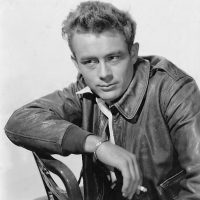
We see his face on T-shirts and towels, posters and postcards, and for decades it has advertised everything from cars, jeans, beer and Pepsi to a bank and a credit card. The surly, hurt expression suggests the epitome of cool, the perfect marketing image for the young. Yet the man that face belonged to has been dead for almost sixty years: if he were alive today he would be 83.
He was the actor James Dean and he was killed in a car crash in 1955 at the age of 24, just six months after his first film, East Of Eden, was released, and days before his second, Rebel Without A Cause, was to be premiered; while his third, Giant, had only just finished shooting. Later this month those three films will be re-released in Britain, while in America, a new movie about him is currently in production.
But who was James Dean and why is he still the object of such lingering fascination? What made him the perpetual symbol of youthful angst? And why, after all this time, does he seem so contemporary?
I’ve been interested in James Dean since at the age of 14 I saw East Of Eden and came out of the cinema thinking he was the first actor I’d ever seen who didn’t look as though he wasn’t acting. Alongside him all other film stars seemed wooden.
I didn’t know then that he, like Marlon Brando, were pioneering a naturalistic form of movie acting they’d learned at the Actors Studio in New York, but when I later saw Martin Sheen, Anthony Perkins and Warren Beatty, I recognized instantly the debt they owed the dead star.
Producer David Puttnam recognized it, too, and when we both grew up we made the documentary James Dean: The First American Teenager, for which I crossed America interviewing Dean’s colleagues and friends.
Dean’s had been a short life. A farm boy from Indiana, brought up by his aunt and uncle after his mother died when he was four, he left home at 18 and then dropped out of college in Los Angeles to take bit parts in movies and commercials.
At 21 he caught the coast-to-coast bus to New York where television was producing weekly live television drama, and, over an 18 month period, appeared in over thirty TV plays, one of them with Ronald Reagan. Then at 23 he was called back to Hollywood to star in East Of Eden.
He flew there, carrying his few belongings in a paper bag, and, with a cash advance for the movie, bought a second hand MG sports car. He loved speed.
Even before East of Eden was released director Elia Kazan and Warner Brothers knew they’d discovered something special, but already Dean was proving difficult in a Hollywood more familiar with the quiescent stars of the studio system.
According to Dennis Hopper, the studio gossip at the time was that before shooting Elia Kazan told the cast and crew that they were about to meet a young actor who would might appear strange and difficult, but who was going to be ‘pure gold on screen’. Then in walked Dean, uttering a string of four letter words.
At which point Raymond Massey, a very religious man who was playing Dean’s father in the film and who didn’t like any cursing on the set, turned to Kazan and said ‘what price is gold?’.
By the time filming was complete, Dean had gathered around himself an unconventional group of friends. Not least among them was a minor celebrity called Maila Nurmi who, in the role of Vampira, used to introduce horror movies on local TV.
‘Jimmy had an Oscar, you know,’ she told me. ‘We stole it from an Oscar thief who had stolen it from Frank Sinatra and we had it inscribed to him.’
Dean’s second film, Rebel Without A Cause, co-starring Natalie Wood and Sal Mineo, was a study of the then new American obsession with middle class delinquency. It was here that Dean’s famous red, zip-up jacket and blue jeans made their appearance – although they nearly didn’t.
Rebel had been planned as a low budget black and white film, and a week’s shooting had taken place in monochrome before, following positive studio reaction to East Of Eden, it was decided to begin again in colour. By such whims are iconic images created.
Almost as though he was racing against time Dean began his third movie, Giant, days after finishing Rebel. This time he appeared alongside Elizabeth Taylor and Rock Hudson. Hudson hated him. ‘He was hard to be around,’ he would say many years later. ‘Full of contempt.’
Dean thought Hudson was a lousy actor. He was right about that. Elizabeth Taylor, however, became a confidante.
Dennis Hopper, who appeared in both Rebel and Giant, told me of Dean’s unusual preparation. ‘We were in Texas and there were people lined up about a hundred feet away from where Jimmy was doing his first scene with Elizabeth Taylor. And suddenly he walked about halfway between where we were shooting and where the people were, nonchalantly unfastened his pants, peed, and then walked back into the scene and got it in one take.’
Why, Hopper asked him.
‘Well, I was really nervous,’ Dean told him. ‘And I figured if I could go and pee in front of all those people I could get back and do anything on film.’
By this time Dean’s fee per movie was soaring, and during Giant he bought a new Porsche Spider. Banned by the studio’s insurers from driving it until filming was completed, he instead appeared, ironically enough, in a road safety commercial.
‘And, remember,’ he ends it, ‘drive safely, because the life you save…might be mine’, laughing to himself as he changed the scripted line from ‘might be yours’. By now he had just thirteen days left to live.
On Friday, September 30, 1955, a week after finishing Giant, he picked up the new Porsche, now with the name ‘Little Bastard’ painted on the front, and set off with a mechanic for a race meeting in Northern California. At three thirty that afternoon a traffic cop gave him a ticket for speeding. Then at 5.45 pm a young student on his way home for the weekend accidentally pulled his old car right across the path of the speeding Porsche.
Dean’s mechanic was thrown clear in the impact and survived with some broken bones. The student had a bruised nose. But Dean, whose feet became entangled in the clutch and brake pedals, was killed instantly. His neck was broken.
Within a few weeks the wrecked Porsche was displayed in a bowling alley in Los Angeles, where fans paid 50 cents to look at it. ‘People were tearing off pieces,’ Maila Nurmi said. ‘There was hardly anything left of it by the time they took it off exhibit.’
When Rebel Without A Cause was released it was a worldwide success. Dean’s image was suddenly like that of a rock star, although he was dead before rock and roll was properly born, before Elvis recorded his first big hit.
But what made him a legend? Some would say that he just happened to come along at the birth of our obsession with youth culture; that his casting as the confused kid fitted the moment to perfection, turning those young, good looks, the jeans and that great hair, into a classic style. Indeed most photographs show him looking lonely, the outsider in the grown-up world.
It was, I’m pretty sure, a look he perfected, because he was certainly narcissistic – encouraging photographers to follow him around, with one even driving in a car behind him on the day he was killed.
Movie composer Leonard Rosenman, who roomed with Dean in New York and went out to Hollywood with the star to write the score for East Of Eden, saw the vanity as ‘a sort of pathological desire for attention…though I don’t really fault him for that, because that’s an occupational disease of an actor, like silicosis to a coal miner.’
Dean was also, Rosenman said, something of a poseur. He’d been first introduced to him as ‘tough kid who sleeps on nails’, but quickly discovered that ‘Jimmy had a tremendous desire to be an intellectual and would carry around books by Kirkegaard and Nietzche. I think he wanted to be different than he really was.’
Jack Larson, who was a television star playing Superman’s side kick Jimmy Olsen at the time, shared Rosenman’s suspicions. He never worked with Dean, but would see him regularly at Hollywood parties. ‘He’d sit at a bongo drum in a corner,’ he said, ‘and be annoying and self indulgent with it while people were trying to talk. And then he’d look up with his kind of hurt little expression. And I thought he didn’t need to do it, poor guy.’
He didn’t need to do it, because, even if those ‘hurt little looks’ have been terrific for advertisers, it’s always seemed to me that his far more important heritage has been his gift to succeeding generation of young actors.
Because, though you may not have realised it, you’ve been watching Dean’s influence on cinema for decades. Remember Warren Beatty in Splendour In The Grass and Martin Sheen in Badlands? This is what Sheen had to say about Dean. ‘He was the greatest actor who ever lived. He was simply a genius.’
Maybe that’s a little too fulsome eve or an actor. So what about Leonardo DiCaprio? Currently he’s reckoned to be just about the best there is in Hollywood, but anyone who saw him in his Oscar nominated role as Arnie in What’s Eating Gilbert Grape when he was just 18, would have spotted the Dean influence immediately.
DiCaprio, who hosted a Dean memorial in New York recently when another Dean fan, director Martin Scorsese, was unable to be there, put it this way. ‘I remember seeing the hunger in James Dean’s eyes in East Of Eden. I watched it five times in a row.’
Marlon Brando is usually credited with having had the greatest effect on movie acting, but I would suggest Dean was equally important. Although Dean was an admitted Brando fan, he was no mere copycat as has been suggested, although, as the bitter Rock Hudson discovered, he was a terrible stealer of scenes – just like Brando.
Carroll Baker, who appeared in Giant, was ambivalent about Dean when I filmed her. ‘Jimmy was the most inventive actor I ever met,’ she began. ‘He was always thinking up marvellous movements and pieces of business…and that often annoys other actors.
‘On my first day ever in front of a camera Jimmy and I had this scene in a booth…and at a certain moment I went into utter shock because Jimmy grabbed me under the table. And I thought that was a very dirty thing to do because I think he did it in order to try to throw me in the scene.’
Or maybe not. Putting aside any possibly lewd interpretation, it would also have fitted Dean’s character in the film – an older man at this stage in the movie coming on to a pretty young girl.
In his eighteen months in Hollywood, Dean liked to quote a line from a movie he’d seen: ‘Live fast, die young and have a good looking corpse.’ Rarely was there a more prophetic testament. But a sculptor and collector of Dean memorabilia called Kenneth Kendall I interviewed in his studio in Los Angeles had the most cynical take on Dean’s early death.
‘There’s one wonderful thing about dead movie stars,’ he said, as he pressed me to try on the jacket that Dean wore in East Of Eden. ‘They can’t disappoint you, which is about all the live ones are capable of doing.’
Ray Connolly’s novel about movie making, Shadows On A Wall, is now available as an eBook. His film James Dean: The First American Teenager is available on DVD.
WHAT OTHER ACTORS SAY ABOUT JAMES DEAN
JOHNNY DEPP: ‘There are moments in East of Eden that are pure magic.’
HARVEY KEITEL: ‘Jimmy had that genius, that mysterious certain something. He was an inspiration to me.’
AL PACINO: ‘Dean was an inspiration…he made that connection with an audience. He reached everybody.’
NICOLAS CAGE (after seeing Dean in East of Eden): ‘It was so real to me, that I knew that acting was what I wanted to do. It affected me more than any song or painting or TV show.’
ROBERT DUVALL: ‘Dean was good, obviously. But he died at a good time.’
