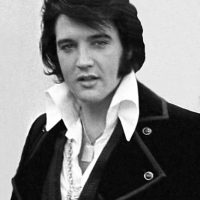
Daily Mail, 2006
Priscilla Beaulieu must have thought she’d gone to live with the Beverly Hillbillies when Elvis Presley talked her parents into letting her leave their home in Germany and join him at Graceland in Memphis in 1962. He might have been the most famous star in the world, but he still lived, as he always would, with his father and grandmother, and with four cooks working around the clock so that fried bacon could be served day or night.
Then there was Auntie Delta and her dog, “the dog out of the movie Omen, the dog from hell”, as Elvis’s daughter Lisa Marie remembers. While grandma would sit in her ruffled dress watching TV, dipping a hickory stick into her little snuff box, always without her false teeth which she’d misplace around the mansion, Delta, in her nightdress and curlers, would be at the gate, “cursing like a sailor” and insulting the fans.
Only the blue jeans of the Hillbillies were missing. To Elvis, who’d grown up poor, blue jeans were the uniform of poverty. After he became successful he only ever wore them when playing a part in a movie.
We learn all this in an extraordinarily candid book, Elvis by the Presleys, in which Elvis’s ex-wife Priscilla and Lisa Marie lift the lid on what it was like to live with the King in his sometimes mad-hatters castle in Tennessee.
And although it’s a book which paints Elvis as a mass of contradictions, a cross between a recklessly over-generous tyrant and religiously obsessed sex symbol, the image it leaves most strongly is that of a tragically lonely man who by the end had no-one to whom he could turn.
How Priscilla came to meet Elvis in 1959 is puzzling. There she was, a fourteen year old schoolgirl living with her parents (her step-father being a US Air Force officer stationed in Germany) when suddenly she’s asked by a complete stranger on the base if she’d like to go with him and his wife to meet Elvis Presley.
At the height of his early fame, Elvis was then serving with the US Army in Germany. He liked his girls young and his pals knew it.
Priscilla’s parents were naturally mystified and worried when she told them, but amazingly they gave their permission and off she went to the star’s house in her blue and white sailor suit dress.
Elvis was instantly hooked, and, still missing his mother who had died the previous year, he told her how much it hurt him that his father was already dating another woman.
Desperately homesick, he fretted about how worried and nervous he was that his fans would have forgotten him by the time he got back to the States. Priscilla sat and listened like a beautiful doll. He called her Little One.
A few days later he phoned her, and kept on phoning. Her parents, wondering what a 24 year old superstar was up to with their under-age daughter, insisted on meeting him, but were soon charmed into submission. Elvis had a lot of charm, and Priscilla insisted that he had “behaved like a perfect gentleman”.
Had her parents known that the second time Elvis met Priscilla he quickly got her upstairs into his bedroom, they might not have been so easily placated. Priscilla, who is now 60, doesn’t mention that in this book, but she did in an earlier autobiography.
All the same she insists that their relationship remained chaste, though the nocturnal Elvis did give her a pep pill to help her stay awake when she went to his house after school and homework. She says she didn’t swallow it, but clearly Elvis was already dabbling with the cocktail of pills which would eventually kill him. “He swallowed them like candy,” she recounts.
Early in 1960 Elvis was demobbed and returned to the US to resume his career, denying in interviews any big relationship with the girl he left behind. Her heart sank.
Her mother said: ” Forget him, honey. It was a lovely chapter in your life, but it’s over. Now you’ve got to focus on school.”
But soon he was back on the phone, assuring Priscilla he wasn’t going out with Nancy Sinatra, telling her he still loved her and sending her all the records he thought she might like—Bryan Hyland’s Sealed With A Kiss and the Drifters’ Save The Last Dance For Me, as well as his own Fever.
No matter how many women threw themselves at him, and in his life he would sample the delights of legions, Priscilla was the one he wanted. He liked the fact that she was a normal girl from a normal family and that she was a virgin.
Her parents, now a genial elderly couple, admit to being astonished. They’d assumed the relationship would quickly fizzle out and that their daughter would have a normal teenage.
It wasn’t to be. After two years the long distance telephone courting wasn’t enough. Elvis wanted Priscilla with him. He sent her airline tickets for her to join him for a holiday in Los Angeles.
“Let me look at you,” he said in amazement when she arrived. “You’re all grown up.” She was actually sixteen.
He looked different, too. “In Germany his hair had been blondish,” she remembers. “Now it was dyed black. He looked great. He was thin and vibrant. He seemed overjoyed to see me. “They were soon in his bedroom.
“I was ready. He wasn’t. He was glad that I’d saved myself but was still committed to my purity. What could I say? What could I do? I wanted him. I know he wanted me, but, according to him, the time wasn’t right.”
Instead they went shopping in Las Vegas, where he chose all her dresses and shoes. As beautiful as she was he wanted to change the way she looked. And now he wanted her with him permanently.
First she had to return to Germany where her parents resisted the idea. Her stepfather says: “I was worried. We were all confused by her friendship with Elvis.” But by that Christmas, Elvis and Priscilla had broken down the resistance. She joined him in Memphis. This time for good.
For Priscilla it was the beginning of a bizarre life. Kept a deadly secret from the Press and the fans she was officially in the care of his grandmother while attending a local girls Catholic high school. But all the time Elvis was moulding this schoolgirl for what he most wanted in a woman.
“Like a sculptor he would shape my image and design my demeanour in ways which that would bring him delight,” she says. “He felt my desire to please him, my lack of ego, my need to live a life devoted to bringing him pleasure. Our pledge was unsigned, but it was nonetheless clear. He would bring me into his world and keep me in his world as long as I understood that my place was to honour him and to satisfy his many needs. I bought that arrangement and for many years devoted myself to making it work.
“It was a double life. I was the prim and proper schoolgirl by day and Elvis’s girl-friend by night.”
It was also an extraordinary world for a girl to grow up in. Already Elvis’s lifestyle had been set and he was constantly surrounded by his minders and bodyguards, known as the Memphis Mafia, who used Graceland as their base. Elvis always liked having an entourage around him, and they went everywhere together.
Nor was Priscilla encouraged to have friends of her own age. Only Elvis’s cousin, Patsy, was deemed safe.
For two years Priscilla had been left behind in Germany, but no sooner was she ensconced in Graceland than Elvis was back in Hollywood making movies. Wandering around the house one dark, thundery afternoon she ventured up into the attic which had always been kept closed.
“I slowly opened the door. It creaked like it hadn’t been opened in years. It was pitch dark inside. I took a couple of steps forward and found the light switch. The yellow bulb lit a long line of clothing racks. They were Elvis’s mother’s clothes. Elvis had saved everything. All her precious belongings were there. One by one I examined her blouses, skirts and dresses…” She tried some of them on.
Elvis may have been an easy man with whom to fall in love, but living with him was different. As much as he loved Priscilla, as much as he showered her with expensive gifts, everything had to be the way he wanted it.
He even decided how she did her hair. “In the Sixties with hair-do’s piled high to the sky, Elvis wanted mine piled highest,” she says. “Think Marge Simpson! He wanted my skirts shorter, my eyeliner darker, my make-up thicker, and my hair dyed the same jet back as his.”
And when she innocently criticised his choice of songs, saying that she preferred him in rockier style, he flew into a rage. She didn’t make that mistake again.
For four years in the mid-Sixties while Priscilla stayed in Memphis, Elvis made a string of movies, flying backwards and forwards to Hollywood. She suspected he had affairs with Ann-Margret, possibly Ursula Andress and many more, but he always denied it, turning defence into offence.
“He’d say I was just jealous,” says Priscilla, “that I was inventing things, confusing his simple friendliness with flirting. His accusations were made with such skill that I’d wind up apologising to him.” It was a pattern that was to be often repeated. Meanwhile their relationship “remained chaste, though we came awfully close to consummation. I was frustrated, but Elvis was adamant.”
At Graceland Elvis was a film buff who watched old black and white classic films all the time, and he’d begun a promising career in films with movies like Loving You and King Creole. But by the Sixties he hated the way his Hollywood life had turned out, and the dreadful songs he found himself singing in cheap beach movies.
Nor, says Priscilla, out of all the actors and directors he worked with, did he have any close movie friends. He didn’t trust Hollywood. He thought the people there were phoneys. “I feel like a fool out there,” he would say, bitterly aware that he was being laughed at by the film community. And when she eventually persuaded him to take her out to Los Angeles she found he avoided the big parties, the charity balls and fancy restaurants.
“Our at-home routine seldom varied. I’d be coiffed before he arrived for dinner at six. Dinner was usually the same–meatloaf, mashed potatoes, gravy and peas.” If they went out in the evening it was usually to ride their motorcycles around the nearby hills behind Malibu.
Priscilla knows Elvis should have stood up to his short sighted manager, the self-styled Colonel Tom Parker and demanded better scripts and better songs. But, hopelessly extravagant, he had an endless need for money, throwing himself totally into mad crazes and insisting that all his Memphis Mafia join in.
One year it was horses, so he bought himself a ranch and then a horse each for all his pals and their wives, whether they wanted one or not. Then it was pick-up trucks. He bought forty on one spending spree alone. Elvis’s attitude was: “I don’t want to be one of those guys who hoards up millions of dollars. I want to share it with my family and friends.”
Ironically, says Priscilla, as much as he earned and as quickly as his money flew out to friends, employees, over fifty charities at Christmas, his in-laws and anyone around who seemed hard up, he liked the simple life. One of the Memphis Mafia, for whom he bought a house in Los Angeles, puts it this way. “He was the sort of guy who’d like to help you, but didn’t want you to help him.”
The car salesmen in Memphis loved him, but to pay for all this he had to earn quick money. And without intelligent advice from an out of touch manager more bad films were the easy answer. When he read the screenplay for the beach movie Clambake he held his nose. But he still did it.
Lisa Marie has a shrewd view of what her father was doing. “He spent more on other people than he did on himself,” she says. “He got a great joy out of giving. It was sort of a relief for him to give.”
Ultra religious since childhood, Elvis had always liked to entertain by quoting from the Bible. But at the lowest point in his career in the mid-Sixties, when he could see himself being eclipsed by the Beatles and Bob Dylan, stars with talent whom he admired, he fell under the influence of a hairdresser who became his guru. Soon he began reading dozens of books on world religions, talking of forming a commune or even going into a monastery to regain spiritual balance.
“My father’s library of religious books is amazing,” says Lisa Marie. “I’ve been through them. They’re covered in his notes. He wrote on the top of the page, on the bottom, in the margins, everywhere.”
His position in the world confused him, says Priscilla: “He wanted to know why it was given to him, why he was the object of so much adulation. ‘Why me?’ he asked over and over. He was convinced his purpose went well beyond music and movies.”
The Colonel wasn’t impressed. And after Elvis had an accident which scared everyone a bonfire was made of many of his religious books, the hairdresser told to keep to cutting hair, and Elvis sent back to Hollywood to make more money.
Then in 1967, when Priscilla was 21, Elvis suddenly proposed. The rumours were that her father threatened him, saying he had to make an honest woman of her. But both father and daughter laugh at that suggestion.
According to Priscilla the long delayed consummation of their relationship didn’t occur until their honeymoon in Palm Springs, and when they got back to Graceland Elvis carried her over the threshold singing Hawaiian Wedding Song, as he had in the movie Blue Hawaii.
It was a time of changes. Elvis’s career was shortly to soar again, but after a happy honeymoon he became restless. Then when Priscilla was seven months pregnant he suddenly, without explanation, suggested a trial separation, then never mentioned it again. She was upset and puzzled.
Lisa Marie was born in 1968, but not before Elvis had taken his time finding a box of cigars that he could pass out at the hospital as Priscilla’s contractions grew ever more severe and more alarming.
Priscilla had expected that the birth of Lisa Marie would bring her and Elvis closer together. The opposite was the case. He avoided intimacy with her. “I remembered him telling me some time in the past that he just couldn’t have sex with a woman who had had a child,” she says. “I felt shut out.”
Quickly Lisa Marie became the new centre of attention at Graceland, a “holy terror” of a spoiled child in a crazy house, a place which turned night into day because Elvis just couldn’t sleep.
“The whole house–his friends, the maids, the cooks, his dad, everyone, was always waiting for my father’s next move,” remembers Lisa Marie. “You never knew when that would be. I remember mentioning one time how much I wanted a puppy. The next I knew it was 3 a.m. and my father had organised a caravan of cars and we were rolling past the gates of Graceland to some pet store where the owner opens up in the middle of the night for this crew of twenty people. That night all twenty got puppies.”
By 1970 Elvis’s career was back at the top again. After his television Comeback Special in 1968, he’d recorded in Memphis again for the first time in fourteen years and been rewarded with two of the biggest hits of his life, In the Ghetto and Suspicious Minds. But now all was not well at home.
For Priscilla the fun of life in the gilded cage was crumbling quickly as she grew into her twenties. Fired by drugs and the new pressures of almost constant performing and rowing with his father about his manager, whom he wanted to fire, Elvis’s behaviour became increasingly eccentric. On one occasion he even flew to Washington and talked his way into not only seeing President Nixon at the White House but having Nixon give him the badge of a federal agent. His charm never left him, but it didn’t work on Priscilla any more.
“At the start of the Seventies my story and Elvis’s story began moving in different directions. The enormity of his career and talent was inevitably the agenda of the day, but when Lisa Marie was born, my agenda shifted. In some ways I felt freer than ever before. I began developing my own interests–in dance for example–and a new sense of self-expression. I was growing and changing.”
And as Elvis spent more and more time either appearing in sell-out seasons in Las Vegas or on tour across America, she began meeting other people outside the group. Eventually she realised she wanted a life of her own. She began an affair with Elvis’s karate instructor.
In 1973 they were divorced. “It was an amazing day,” says Priscilla, “because as we sat in the judge’s chambers and signed the final decree we held hands. There was nothing hostile about it. Elvis was tender and sweet with me.”
But she noticed something that worried her. “His hands, always smooth, were puffy and swollen. I knew something was different, something was wrong. I could see it in his eyes. I could feel it in his hands.”
Lisa Marie now divided her time between Priscilla in Los Angeles and Elvis in Memphis. Life in Graceland seems to have been madder than ever.
One night she says she “was woken in the early hours by an incredible noise coming from my father’s bedroom. I got out of bed and saw the guys buzz-sawing down his door so that they could move a grand piano in.” Elvis had apparently felt like playing and singing some gospel songs in his bedroom.
He wasn’t, however, always singing. “His temper was scary. It could give Darth Vader a run for his money,” she says. “The times he reprimanded me were devastating, but then in the middle of the night he’d come into my room and, with a puppet in his hand, sing me a song like Can’t Help Falling In Love With You.”
He remained insecure, too, and jealous of other performers. One Christmas Lisa Marie remembers asking for Elton John albums. “Well, my father wouldn’t get them. But Aunt Delta, who couldn’t care less what her nephew thought, went out and got them. So there we all were on Christmas morning, sitting under the tree and opening presents. But as soon as I unwrap my Elton John records my father grabs them and says, ‘Who is this guy? Why should my daughter be listening to him and not me?’
“The truth was I did listen to his records all the time, and I loved them. It was just that this new guy’s music caught my ear. It wasn’t long after that, though, that my father came around and started listening to Elton himself. He even went to an Elton John concert.”
The final downward spiral of Elvis Presley, however, was beginning. As Priscilla began a new life Elvis couldn’t let go. He begged her parents, to whom he still remained close, to intercede on his behalf and convince her to go back to him. They tried, but it was too late. All the same he would turn up at Priscilla’s home in Los Angeles and talk for hours.
“It might be 2 a.m. Time didn’t matter to him. Elvis was always calling, saying he was on his way over with a song for me to hear or a new book for me to read. He was deep into numerology and wanted to explain its meaning. But basically he was lonely and needed company. He needed to reconnect with his family. We talked more after we were divorced than before. But nothing had changed.”
There was to be no reconciliation. Priscilla worried about the endless diet of pills he was taking, but neither she nor anyone else was able to intervene. Elvis was frightened of street drugs and hateful of drug pushers, but because he only took prescription drugs he never believed he was an addict. Now, however, those drugs began to take over his life.
Depressed, he retreated further and further into himself, most of the best new songs he sang being, like Always On My Mind, about the break-up of his marriage. At Graceland his bedroom was once again stuffed with books on religion. In one he’d written some advice he’d been given by a member of a New Age cult. It read. “God loves you. But he loves you best when you sing.”
Guns began to play an ever bigger part in his life. On stage he always carried one down his boot in case he was attacked, and if he didn’t like a programme on television he would casually put a bullet through the screen.
One afternoon at Graceland when Lisa Marie was watching Sesame Street on television she heard a shot. Running outside she found Elvis sunbathing on a chair holding a smoking gun. “Don’t worry, baby,” he said. “A snake crawled out of the tree but it’s not going to bother anyone now.”
His behaviour became increasingly erratic, sometimes leading to long rambling monologues on stage. Occasionally he could be funny, such as the occasions he would attach a blue police light on the top of his car, pull over a driver, and show off one of his many badges. “Son,” he’d say, “you were speeding. I just want to warn you to slow down,” just so that he could see the expression on the face of the driver when he realised who’d stopped him.
But there was little joy left in his life. Alone in his Las Vegas hotel room after concerts he would sit wide awake through the night. “I feel so alone sometimes, the night is so quiet for me. I would love to be able to sleep. I’m glad is everyone is gone now. I will probably not rest tonight. I have no need for all of this. Help me, Lord,” he wrote one night on a scrap of paper.
The end came suddenly. Lisa Marie was staying with her father in Memphis. She was nine but she could sense the state Elvis was in. “I could see he was struggling. I could feel that he was very sad. He’d come into my room walking so unsteadily that sometimes he’d start to fall and I’d have to catch him. He had his own chair in my bedroom where he would sit, watch my TV and smoke cigars.”
On August 16, 1977, finding her still awake at 4 a.m., he told her to go to bed. Then he went in to see her and kissed her good night.
He died in his bathroom early the following afternoon, aged 42, just four years after his divorce, a bloated wreck of an unhappy man.
Of his end Priscilla says: “He was misunderstood by all those around him. We underestimated his emotional pain. And he lacked the means to fully express that pain.”
Fittingly one of the last songs he’d sung, sitting at his piano in the middle of the night, had been a gospel hymn. On the turntable of his record player that day was a new album by a favourite gospel quartet.
“I don’t know who I can talk to anymore,” read another note he’d written to himself. “I only have myself and the Lord. Help me, Lord, to know the right thing.”
