Daily Mail, June 18, 2012
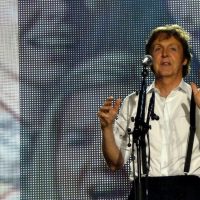
The perfectionist in Paul McCartney won’t have enjoyed it, but, with his voice scratchy and strained, he sounded and looked exhausted as he closed the show at the Diamond Jubilee Concert a couple of weeks ago. Perhaps, though, his tiredness was to be expected. His short performance at Buckingham Palace was his thirty second in the past year with all the others having lasted for two and half hours each.
In rock music terms that’s more than marathon length in giving value for money. And, though he’s long been known for his boyishness, Paul McCartney is getting on. He’s 70 today.
He’s also, as one of the two surviving Beatles, one of the few individuals who can justifiably be referred to as a British national treasure – and not just for the treasure that as a major exporter of music, and never a tax exile like some of his peers, he’s brought to this country.
Of far greater importance has been his contribution to the cultural wealth of our nation where playgroup children sing Yellow Submarine believing it to be a nursery rhyme, and residents of old folks homes join in to When I’m Sixty Four, and wish they still were.
Then there are his evocations of British suburban life in Penny Lane and She’s Leaving Home, and his timeless classics, Yesterday, recorded by over 2,500 other artists, Let It Be and Hey Jude – all songs which defy musical fashion and have leapt across the generations since he wrote them in his twenties.
You might wonder why a man now well past retirement age, with a fortune reckoned to be getting on for £500 million pounds, who has written or co-written something like eighty other hit songs and played time and again in all the world’s major cities keeps on going. His place in history has been assured for forty years.
But that would be to overlook what pushes Paul McCartney. Because, not only is he a man who just has to keep busy, he is also a born entertainer. It isn’t enough for him to simply write and record his songs and then go on holiday. He needs to get out there, face the crowds and sing to them, as he did when he wasn’t much more than a boy at Liverpool’s tiny Cavern Club and again a few weeks ago before an audience of over 200,000 in Mexico City.
Nor is it sufficient for him to limit his abilities to popular songs. He’s also written film scores and three major works of serious music as well as a ballet, while for the past fifteen years he’s enjoyed a separate, virtually anonymous, occasional identity with the Fireman, a progressive electronic rock band. Then there was his book of poems and his exhibitions of paintings.
These side interests might not equal the degree of brilliance he demonstrated in his classic songs, Eleanor Rigby, Blackbird and Here There And Everywhere, but they are evidence of a man who just has to keep stretching himself.
As a star he can be friendly, cautious and diplomatic, and, it is said, as a colleague or employer, both understanding and helpful. But he can also be critical, preachy and bossy. He knows how good he is and he knows how he wants things. What he’s never been is lazy.
That’s the way he always was, since, with the other Beatles, he first entered EMI Records’ Abbey Road studios exactly fifty years ago this month to make their first hit record, Love Me Do.
That day changed all their lives, and ours, too, but with two big hits before he was 21, Please Please Me and From Me To You, it also means that Paul McCartney has been impossibly famous all his adult life.
It’s unlikely he realised it when he won a Liverpool schools essay writing competition at the age of 11 (he chose a book on modern art as his prize – telling in one so young), but his sights were set early on making a name for himself.
His future partner in song, John Lennon, whom he met when he was 15, once joked to me that he’d ruined McCartney’s life – that Paul could have become a teacher or a doctor if it hadn’t been for him.
But, in truth, music was always going to be Paul’s future. He instinctively understood melodic composition.
Back in the Twenties his father, Jim McCartney, had had his own trad jazz band, but rock and roll was the style, as Paul, John and George Harrison evolved the Beatles’ sound. Even so Paul was quick to point out in his flush of fame that the songs he and Lennon wrote just happened to be to a contemporary rock beat, and might equally have been played to other rhythms had they been fashionable.
His partnership with John Lennon was obviously the making of his career – sharing the composing credits, as Lennon and McCartney, even when one or the other had been the sole writer. It was a perfect union of equals, as either Paul or John would suggest chords, lyrics and harmony to the other’s idea.
“The collaboration with John made everything twice as easy,” he once explained to me, “and I think I’m right in saying it made it twice as easy for John, too. We’d do three-hour sessions and never once did we come out of them empty-handed. All those songs, such as Eleanor Rigby, Help!, Norwegian Wood, came directly out of the collaboration. We were both good. If he got stuck, I could always help him. Always. I never failed to help him. And, if I was stuck, he never failed to help me. Never.
“I remember turning up at his house one day with Paperback Writer, which I’d been making up in the car on the way down to Weybridge where he lived then. I showed him how it went and the lyrics, and all he said was, ‘Yes…yes…yes’.
“All he did that day was confirm what I was doing. But that was amazingly important. Without him, I would have sat and worried for ever over it. That was John’s great strength. He was like a good editor. He could make decisions quickly.”
Lennon’s quick decision to disband the Beatles in 1969 at the very height of their fame, however, left McCartney in an abyss of despair. Although he and Lennon had given up writing jointly by then, largely because of the unsettling presence of Lennon’s second wife Yoko Ono while they were working, he couldn’t imagine a life for himself outside the Beatles.
He was, he said, just as much a Beatle fan as anyone else and went slightly off the rails, drinking too much at his croft in Scotland. Neither did it help that Lennon, in a confessional mood at the time, put barbs into both songs and magazine interviews about his former best friend. To his credit, I can’t recall a single occasion when Paul bit back in print, though I know how hurt he was.
The Beatles, and the organisation built around them, had been like a family to him, so as internal Beatle rows moved to court proceedings, his solution was to create a family of his own, a real one, with his wife, American Linda Eastman, whom he’d married in 1969.
It was a complete change of life and proved to be a spectacularly successful marriage where another side of McCartney quickly emerged. That was a deeply conservative desire to live, despite his fame and wealth, as ordinary a family life as possible, with the McCartneys’ four children going to state schools near the country house they built in the Sussex woods he’d bought.
A master of half a dozen instruments which had led him to occasionally play drums, piano or lead guitar as well as his usual bass on various Beatle sessions, his first work outside the group was a solo album, McCartney, on which he played all the instruments himself.
But a one man band couldn’t have toured and soon he had a new group, Wings, and the hits and tours began again. Some of the songs were brilliant, Another Day, Band On The Run, Jet and Live And Let Die, while Mull Of Kintyre became the biggest selling UK single of the Seventies. Others weren’t so good.
What McCartney probably lacked was Lennon’s blunt criticisms. It’s been said that he never knows which are his best songs until someone else tells him. But without the other Beatles, who was there to tell the man who many consider a genius of melody that some of his songs weren’t up to scratch? It would have been a brave employee or musician. It still would.
While Lennon was alive, there was always the possibility that the two might find a way of working together again. Then in 1980 Lennon was murdered, and that chance was gone. So, Paul worked with other artists, Michael Jackson and Elvis Costello, and more hits inevitably came.
Seemingly whatever he did found success, be it the children’s favourite We All Stand Together from the Rupert Bear animated film he produced or his number one Ebony and Ivory with Stevie Wonder.
Middle age, a growing family and domesticity suited him. He had a studio built a few miles from his Sussex home where he collected old instruments used on Beatles record, and the stand-up bass used on Elvis Presley’s Heartbreak Hotel, a song which had been a turning point in his life, and he and Linda rode their appaloosa horses across his ever growing estate.
While for work he first composed his first extended piece or serious music, Liverpool Oratorio with Carl Davis (who described him as the most disciplined person he has ever known) backed his wife Linda’s vegetarian foods, and built a very large music publishing company which includes songs by Buddy Holly and Hoagy Carmichael, as well as the musicals Grease, A Chorus Line and Guys And Dolls. Then there was his commitment as a major sponsor establishing the Liverpool Institute For Performing Arts.
Unlike other Beatles, his close ties with Liverpool have never left him. He still owns a house across the Mersey on the Wirral and gives privately to Liverpool charities, including Alder Hey Children’s Hospital. While known as an animal rights supporter and anti-land mines campaigner, other charitable work has been kept secret.
His knighthood in 1997 came surprisingly late in his career (a decision thought to be not unconnected with his several arrests for possession of marijuana), and he was proud of it. Sadly, though, a year later, just as Stella, his and Linda’s second daughter, was beginning to make headway in the fashion world, Linda died from breast cancer, the illness that had taken his mother when he’d been 14.
The centre of his family was gone. His children were growing up. For months he just stayed at home.
He was forced to change his life again, but his second marriage in 2002 to former model Heather Mills was to prove an expensive and acrimonious, on the bride’s side, mistake. After the birth of their daughter, Beatrice, the couple were divorced in 2008.
Nothing, however, could stop the McCartney work rate as for over a decade world tours have followed each other almost annually. For years after the Beatles broke up he’d refused to sing any of his hits written with John Lennon. Now, with the wounds healed, his shows contain so many, his latest group has jokingly been referred to as the “Best Beatles Tribute Band in the World”.
He writes theme songs for films, too, if the right person asks him nicely, one for the Tom Cruise film Vanilla Sky another for Robert de Niro’s Everybody’s Fine, a movie about a man whose wife dies and who wants to get his children home for Christmas. Children remain a large part of his life, with his son James now following in his footsteps as a singer- songwriter.
Paul’s detractors will tell you that it’s well over a decade since he had a really big single, suggesting perhaps that his gift for melody has left him. Certainly writing hits isn’t as seemingly effortless as once it was – he woke up, he says, in 1964, with Yesterday fully formed in his mind as if he’d dreamt it.
But an alternative interpretation might be that, although there’s a massive market for his Beatles’ and Wings’ material, styles have changed and much less attention is paid to his recent work. If he were to write a song as good as Yesterday today would it get the attention it deserved?
Maybe not. His latest single, My Valentine, written for his new wife, old friend New Yorker, Nancy Shevell, whom he married last October, had Eric Clapton on guitar and promo films starring Johnny Depp and Natalie Portman, but it still didn’t do well in the charts. Disc jockeys would rather play his earlier stuff, while sales of his album of standards, Kisses On The Bottom, with its Thirties and Forties songs, were disappointing.
Quite why he’s never turned his attention to writing a full scale musical for the West End, when he’s tried virtually everything else in music, and his companies publish the music to several American shows, is hard to fathom.
Producers put on shows based around old Beatle hits, with a new one, Let It Be, due to open in September. But there must be at least a dozen overlooked McCartney gems in his back catalogue which, with the right story, could be refashioned for the stage in the way Cole Porter or George Gershwin gave songs that hadn’t made it another lease of life in a new show. Or is it too late for him to take on Andrew Lloyd Webber?
Whatever he does next, as, with Nancy his life changes again and he spends more time at their US homes in New York and on Long Island, and he slips between his UK homes by helicopter, he’s sure to find something new to keep him busy. His very nature insists on it.
In the meantime, Paul McCartney, honorary fellow of the Royal College of Music, who still claims jokily and slightly ingenuously that he can’t read music, will go on being festooned with honours, like the Gershwin prize that President Obama recently bestowed on him at the White House, and, no doubt, touring.
And if you missed him at Buckingham Palace you only have a few weeks to wait until you can see him again as he closes the opening ceremony of the London Olympics on July 27. It had to be him. With no disrespect to Ringo, no performer in Britain, or even in the world, comes bigger than the still singing, still playing, living representative of the Beatles – Paul McCartney.
