October 2010
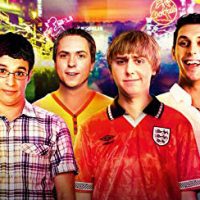
Neither man nor monkey. That was how wise grandmothers would once describe teenage boys, and if we need evidence that nothing really changes over the generations ‒ not in human development, anyway ‒ we need look no further than The Inbetweeners, an award winning comedy show than can be seen on the digital station E4 tonight.
Not that those of a sensitive or prudish disposition should be encouraged to go looking for it. If they do, they’ll be aghast at the language that spills out of the mouths of four sixth form boys at a London comprehensive school.
With repeated slang references to parts of the body not often given even their Latin names in other comedy programmes, and with male hydraulics and manually generated emissions being particular obsessions, this is not a programme for the delicate viewer. Grange Hill this isn’t.
That being said, though everything is grossly, comically overstated, there will be few male readers who don’t recognise at least the tone and territory of the banter, remembering it from their own schooldays, when it was perhaps delivered in a more diluted form.
And take away the explicit crudeness of tongue, what we find at the root of The Inbetweeners is an innocence ‒ that eternal comedy of youthful embarrassment and confusion that is the lot of being a sixteen year old boy.
In many primitive societies there are coming of age rites and challenges to endure at this time of a lad’s life. All we have now are hormones bubbling like geysers and obsessions with sex and self image, with hardly a notion of what to do about either.
The four leading characters of The Inbetweeners are the kind who don’t quite fit in anywhere else at their school and therefore gang-up together. There’s the crude Cockney boy Jay who’s given to absurd exaggerations about his sexual successes; the nice looking Simon who’s hopelessly in love with pretty Carli; Neil, the gawky one, who gets physically over-excited while dancing with a woman teacher at the school hop; and Will, the story-teller, the boy who’s come from a public school and is now trying to make sense of a different world. Though whether the language would be any different, I very much doubt.
It’s all very silly and often gross, but last week’s episode about a school fashion show was undeniably funny. There they go, four ordinary boys, older brothers perhaps of Kevin and Perry, destined to repeatedly make idiots of themselves in their desperation to find outlets for their needs, totally out of sync with the emotionally more mature girls in their class.
As a series The Inbetweeners might not be the most accurate portrayal of contemporary sixth form life ‒ I hope not, anyway, but it certainly taps into that period in most boys lives when girls are a mesmerising yet terrifying fantasy.
Parties are often the venues where modern rites of passage take place, from getting drunk to first sex and drugs, and though initiations may occur a little earlier these days than they did when I was young, there are still bridges that have to be crossed, mistakes to be made.
And in many ways what the Inbetweeners suffer is not that different from the embarrassment at my first teenage party. Then someone suggested putting out the lights and playing a game where the boys sat down and the girls went round the room sitting on the boys’ knees and “necking” with them before moving on to the next boy.
It should have been great fun, except I didn’t know what “necking” was. I knew what “snogging” was, although I’d never done it, but “necking”? This was a word I’d heard but didn’t understand.
In my fevered, and very callow brow, I decided it must be something quite different from snogging, an erotic variation, perhaps, having read in a copy of the Readers Digest at the barbers that the neck was an erogenous zone.
So as the lights went out a succession of bewildered girls made their way around the darkened room to my knees and turned their pliant young lips to mine ‒ only to find me dodging mine away and rubbing my neck against theirs like a rabid swan.
And though the game went on for much of the evening, because obviously everyone else was enjoying it very much, never once did my lips touch another’s. That’s absolutely true. There must be women, now in their sixties, all over West Lancashire still wondering what was going on that night.
Perhaps it isn’t surprising that I wasn’t romantically very successful, with girls usually telling me that they liked me “as a friend”, which, after the death penalty, must be the worst words any teenage boy will ever hear.
But as The Inbetweeners and adolescent boys have discovered from time immemorial it’s impossible to get it right with girls. Their signs and rules are so difficult to read. There was one occasion, for instance, when, at 17, having taken a girl home from a party in the family car, I ventured to put an arm around her.
She looked at me in horror and said: “Oh, Ray, do we have to behave like animals?” I should have said “Well, yes, I was rather hoping we would”, but I was too mortified.
Yet, not very long after that, while going from one party to the next, another girl I was with said: “You know, Ray, I feel really randy.” To which I responded helpfully, “Oh, well, Olly Morrison’s going to be there. You could get off with him.”
“That’s bloody rude,” came the reply.
See what I mean. Boys just can’t win.
We all recognise the boy like Jay in The Inbetweeners, who wildly exaggerates his conquests. I have a friend who claimed for years that not only would the goings-on between the girls and boys on the top deck of his school bus have made Nero blush, but also that as a sixth former he’d lost his virginity to the girls’ gym teacher. Only recently, thirty years after the event, did he admit that he and the teacher “never actually did it”.
The frustrations (and fibs) of teenage boys and young men have always made for good sit-com, ever since The Likely Lads in the Sixties, but the dialogue and stories have always to be tailored to suit the sensibilities of television audiences.
The strength of The Inbetweeners is that its characters’ needs and language more honestly reflect their age and ages, warts and all ‒ or, if we’re being honest, mainly warts, because some of their behaviour is pretty gross.
Written and produced by former stand-up comedian Iain Morris and Damon Beesley, the series has been building viewers since it began on Channel 4’s tiny digital offshoot E4 just over two years ago. The third series which is currently running, is now attracting over two million viewers, but will, say the writers be the last, as the boys reach the end of their sixth form. A film is now being planned as well as an American version.
No doubt the vulgarity of the language will come in for increasing criticism as the show becomes more popular. That’s only to be expected. I’ve written before that I found it crass for the “F” word to be used on a chat show aimed at a mass BBC-1 national audience of all ages, as was the case with the Jonathan Ross programme. Actually I thought it was celebrity bullying.
But horses for courses. I’ve less problem with four letter words in the splintered world of niche, digital television and YouTube, which is where most viewers will watch The Inbetweeners. Hardly anyone who is likely to be upset will be honestly able to say that came across it by accident.
Way over the top though it may be, coarse and sometimes puerile though it certainly sometimes is, young people recognise themselves and some of their language in a lampooned form in this show. Adults may not like to admit it, but this is how a lot of teenage boys are. And if we modify the language a little bit, we’ll remember that’s how they always were. Neither men nor monkeys.
And, though parents may not like The Inbetweeners, their teenage children do.
