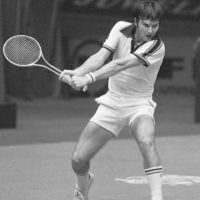
Television Review, Evening Standard, July 1982
At around 5.30 yesterday afternoon it occurred to me that, if there were any two people with whom I would not wish to be stuck in a lift, one was John McEnroe and the other Jimmy Connors.
At that time Connors was beginning to do his mad axeman act as his eyes glazed over with the scent of victory and, with clenched fists, he bawled defiance at the heavens for every shot that went in, before goose-stepping, fingers popping, back to his line.
He seemed like a man in the grip of some demonic possession, and he was alive and loose not two miles from my own home. Getting up, I locked and bolted the door lest the champion-to-be should escape the Centre Court and come looking for me.
There is something of the Jack Nicholson in Connors. The postman might always ring twice, but you can’t be sure with these wild men of tennis.
The chap on the other side of the net was by this time in a state of some equal mental disbalance, muttering, screaming and shouting to himself as though conversing with unheard voices. I cannot imagine what psychiatrists make of the Saint Joan spirit in John McEnroe. I know what I think. We all know about people who talk to themselves.
John McEnroe, for all his skills, reminds me of nothing so much as a disturbed child, so total is the concentration, so selfish the attitude, so sulky the sportsman.
Born in another time, he would have made a wonderful star for those teenage delinquent movies of the 50s, all rebellion authority-hating and forever sorry for himself. He could have made a fortune playing the lead in such classic films as I Was A Teenage Werewolf, frightening us all into craven submission.
My theory is that he should have stuck to soccer, but was convinced by either his father, teacher or coach that there was more money in tennis. And, ever since, the poor lad has been convinced that everyone older than himself or in a position of some authority is yet another manifestation of those who drove him into a sport which he so obviously detests.
Another clue to this attitude might be detected in his behaviour towards Peter Webster, the shiny-pated linesman who, after giving a succession of calls with which McEnroe disagreed, found himself the subject of some hysterical abuse. “You’ve got to be kidding,” screamed the American werewolf in London before beginning a loathsome incantation of “baldy …. baldy.”
Could it be that our young hero has a subconscious resentment towards older men who are short of hair on top? Is that why Mr McEnroe senior always wears that white sun-hat through the lashing winds and rains of a Wimbledon summer? Is he trying to hide something?
Dan Maskell, who himself is not over-endowed with hair, was almost angry. “This is unbearable,” he muttered, killing with politeness. “McEnroe is clearly very much out of sorts with himself.”
As a game of tennis, it was all about as sporting as The Battle of Borodino. While McEnroe burned and smouldered at one end, turning his laser eyes on any poor unsuspecting linesman who had the unenviable task of officiating the game as laid down by the Rule Book, Connors was collecting a penalty point for persistent rudeness.
“If looks could kill, we’d have several dead linesmen today,” someone said. Bob Jenkins, the umpire, wouldn’t have been so lucky. He’d have been vaporised.
Then suddenly, it was all over. Connors went into a clinch with a comely Barbie-doll, who, I understand, is his wife; and the crazy, mixed-up, misunderstood kid became catatonic with grief. It was the first time that McEnroe had been silent all day.
The War of Wimbledon, the battle between players and officials that is, was over for another year. It only remained for the All England Lawn Tennis Club to invite John McEnroe to become a member. As the saying goes, I cannot imagine that he would wish to join any club that would have him as a member.
